How does Wilfred Owen expose the brutality of war through his language in ‘Dulce et decorum Est’?
Brutal. Agonising. Heart wrenching. These are just a few words that came to my mind when I first read Wilfred Owen’s poem ‘Dulce et Decorum Est’ and continuously float around in my thoughts when I look upon the poem again and again. As Owen was both an English poet and soldier and lived between the years 1839 and 1918, I could truly feel his experience of being present during the war. According to Owen,
“My subject is war, and the pity of war. The poetry is in the pity”.
– Wilfred Owen
This quote perfectly describes the theme of Owen’s work, particularly the poem, ‘Dulce et Decorum Est’, as it conveys the brutal nature of a gas attack during the war. Owen instantly reaches for readers attention through the title, alluding to the Latin phrase from the Roman Poet Horace, meaning, “It is sweet and fitting to die for one’s country” (Horace, line 13).
Now, I know what you may be thinking. He says it is sweet and fitting. What does this have to do with it being brutal, agonising or heart wrenching? Well, Owen embedded a paradox in the title and for this reason, it bears great power. He mocks this phrase, showing readers through his emotive and harsh language in the poem, the many reasons why it is neither ‘sweet’ nor ‘fitting’ for one to endure such an agonising demise.
Owen portrays the soldiers as “bent double, like old beggars under sacks, Knock-kneed, coughing like hags” (Owen lines 1-2). The use of alliteration and the simile places an emphasis on the harshness of war and its effect on the soldiers, rather than the glorified image broadcasted by Horace. So blinded by patriotism, the soldiers subjected themselves to the agonising conditions of war without truly understanding the repercussions, both physical and psychological.
The soldiers, “cursed through sludge, Till on the haunting flares we turned our backs, And towards our distant rest began to trudge ” (Owen lines 2-4 ). Through the implementation of the Iambic pentameter, the ‘journey’ of the soldiers through their harsh environment is communicated. This highlights how war has become embedded into their routine. They ‘curse through sludge’ as rather than being driven by patriotism, they are driven by their necessity to survive. Eerie. The tone is truly eerie. These soldiers are distancing themselves from the threat in front of them, however, the threat is never truly gone. They seek refuge, however, the refuge to which they are travelling to is beyond their reach, countering any hope that may have existed.
The soldiers, “marched asleep…all went lame; all blind; Drunk with fatigue; deaf even to …..gas-shells dropping softly behind them” (Owen lines 5-8). The use of alliteration and past tense highlights the torment endured by the soldiers. Personification allows readers to view how the soldiers have become intoxicated with fatigue, dead inside. War has warped their perception of reality, damaged the essence of the human being as now they are numb to the sound of explosives. Are they even still human anymore?
Although Owen shifts from the physical battlefield, he conveys how the trauma is a burden, manifesting itself in the battlefield within his mind. The nightmares ensure that the horror is inescapable and is revealed through his use of onomatopoeia in, “He plunges at me, guttering, choking, drowning” (Owen lines 15-18). This is a truly frightening visual, vivid and eerie. Owen challenged Horace’s ode, showing readers the opposite of the glorified image of war, its brutal nature.
The soldiers, once patriotic, became injured, haunted and entangled in the horror of war. The soldiers, once human, became something else.

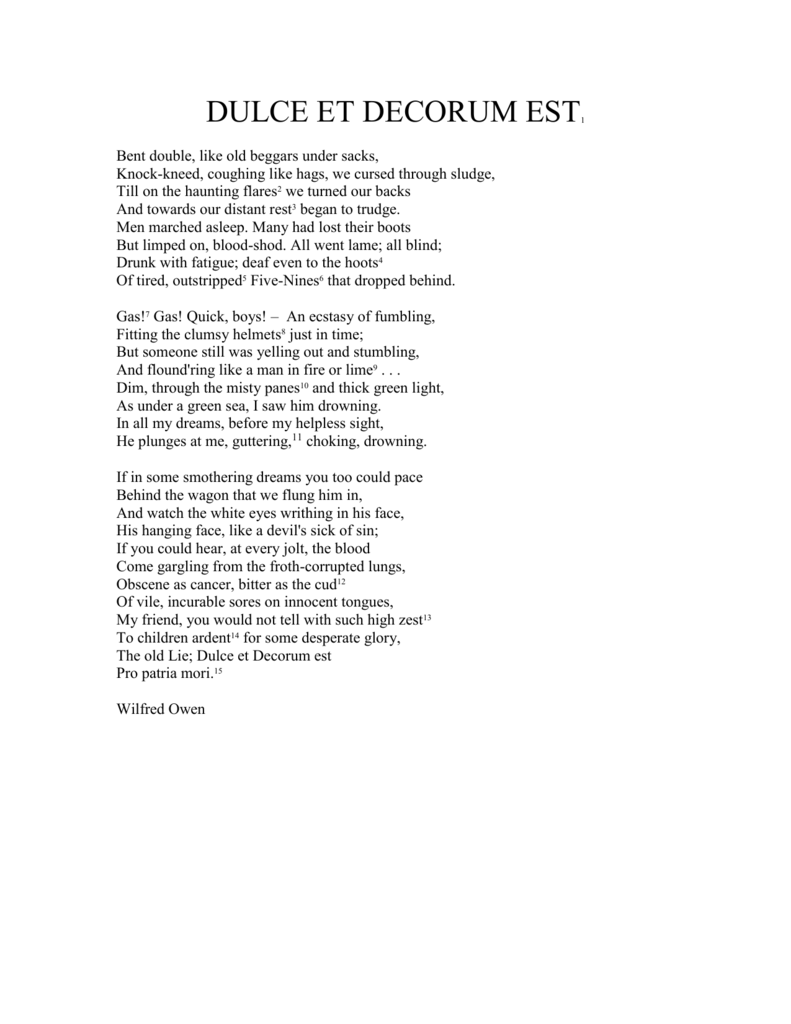
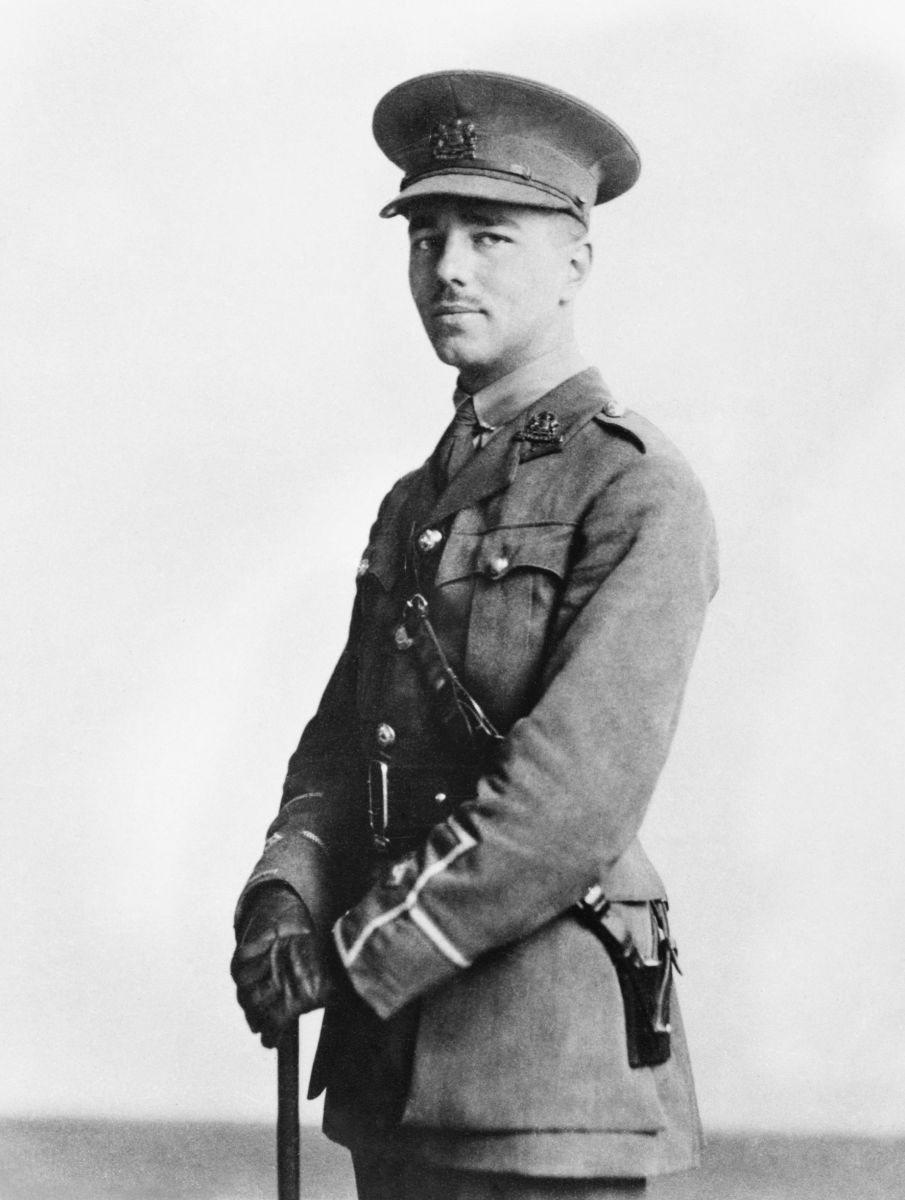
POEM: https://www.poetryfoundation.org/poems/46560/dulce-et-decorum-est
PICTURE 2: https://studylib.net/doc/7844953/dulce-et-decorum-est1-mrsbowieintermediatetwoenglish
PICTURE 3: https://www.theatrecloud.com/news/who-was-wilfred-owen


 Holly’s Blog
A sensitive and detailed appreciation of the poem Holly. Good work.
LikeLike