PLANNING FOR TEACHING AND LEARNING
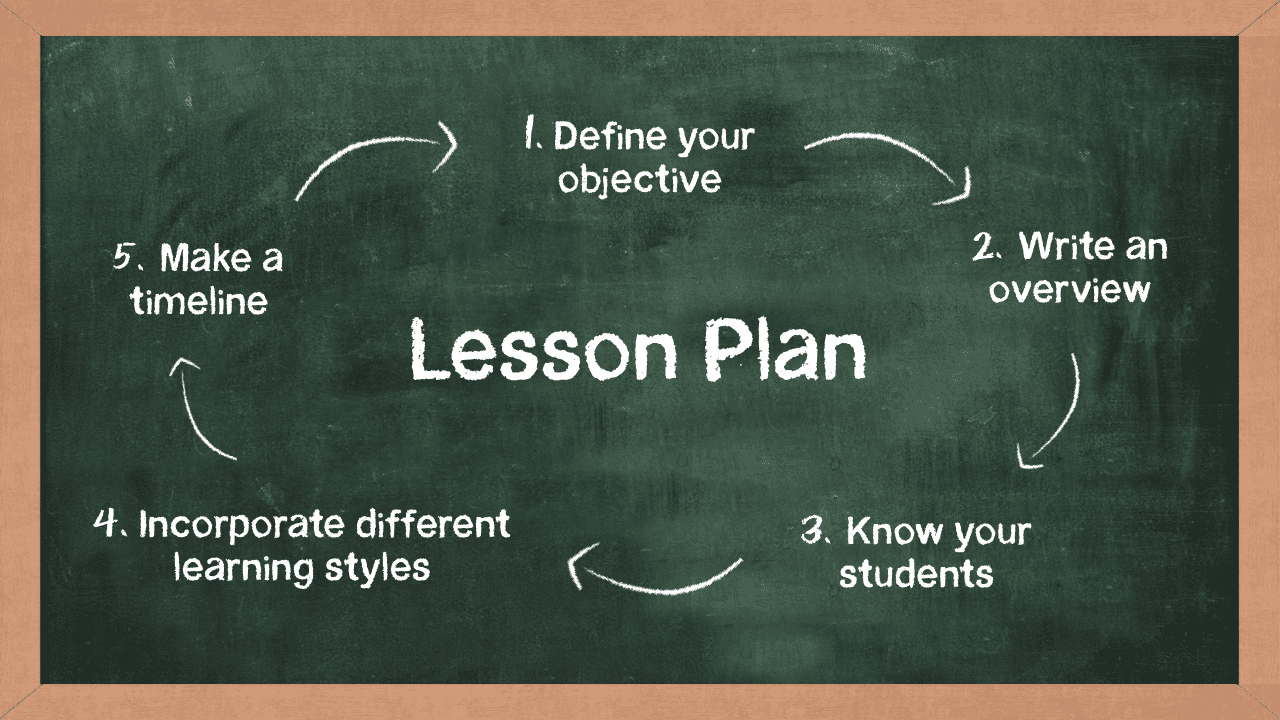
According to Cicek (2013), “A successful lesson plan establishes rules and procedures for how to begin, proceed and end the class, reinforcing a sense of structure and consistency and communicating that the classroom is a place for learning helps students know what to expect” (p. 336). A clear introduction, development and conclusion is critical in establishing and evaluating if learning objectives and success criteria have been met, aspects which form the basis of an effective lesson plan (Richards, 1998). Thus, learning experiences created and developed must be student-centred in order for education to be authentic and student growth to occur in the learning cycle (Dymoke & Harrison, 2008). With reference to a lesson (Year 7 English, Unit – ‘Stand and Deliver’) that I scaffolded and taught, the AITSL standards which instructed my approach to creating an effective lesson included 1.1, 1.2, 2.2, 2.3, 2.6, 3.1, 3.2, 3.3, 3.4, 3.5, 4.2 and 5.4 (2017). This ensured that I acknowledged the context of my class, set learning goals that were achievable, implemented a range of teaching strategies and assessed students’ learning in order to scaffold effective lessons in the future (AITSL, 2017).
Teachings in Education. (2018, January 25). Lesson Planning: What is Required? [Video]. YouTube. https://youtu.be/XPpW9UVb_90
I believe that my introduction was highly effective as I set short and clear learning objectives; clarifying classroom expectations and ascertaining students’ pre-existing knowledge. Students were provided with clarity concerning the aim of the lesson and the notion of the classroom being a place for learning was reinforced, necessary for students to engage effectively in the ‘development’ of the lesson (Cicek, 2013). It was only through delivering the lesson that I was able to appreciate the essence of learning as a nonlinear process, influenced by internal and external factors, rather than a destination (Trumbull & Lash, 2013). Whilst a clear, structured and consistent lesson plan is crucial, it is not necessarily ‘realistic’ to accomplish all goals outlined in theory. Attempting to include a vast amount of activities in a mixed-ability environment affected my ability to control the timing of activities (Butt, 2008, Churchill et al., 2013). Thus, within the ‘development’, all learning objectives and success criteria were not achieved as intended. This included the completion of a glossary of key terminology, viewing/note-taking/discussion concerning the power of ‘emotions’ in drama, engagement in a charades activity and completion of a reflection. Thus, the assessment ‘for learning’ (NESA, 2021), indicated within learning objectives, was altered in order to suit the pace of learners’ in the classroom. Through adjusting the lesson, I was able to maintain focus upon the class discussion as this assisted in consolidating student understanding, developing students deep-thinking skills and would enable students to engage meaningfully in the subsequent activities (Harden, 2007) I believe it was necessary not to proceed with activities with the intention of completion but rather focus upon the quality of active understanding (Brookhart, 2010).
Despite being unable to complete two learning objectives, I maintain that the ‘conclusion’ of a lesson is of paramount importance. It enables the evaluation of teaching and learning practices to occur and expectations concerning the follow-up lesson to be verbalised, reinforcing clarity and consistency (Cicek, 2013). I prompted students to complete the exit slip, enabling them to digest and contemplate what had been discussed in the classroom (Leigh, 2012). This encouraged students to process new information, engage in self-reflection and develop intrapersonal skills (Leigh, 2012). As Butt (2008) stipulates, focusing on the ‘conclusion’ of a lesson develops a “circular relationship that helps to ensure good teaching and learning” (p.3). Thus, I was able to review responses in order to ascertain students’ current understanding, mould my teaching practices to suit the context of my class and ultimately engage in professional development (Churchill et al., 2013).
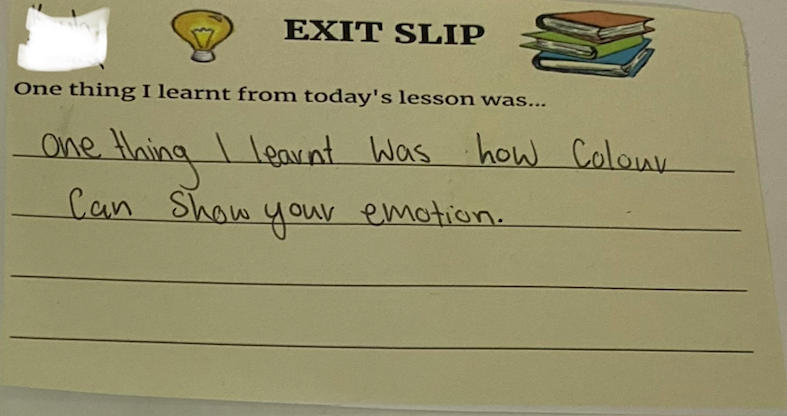
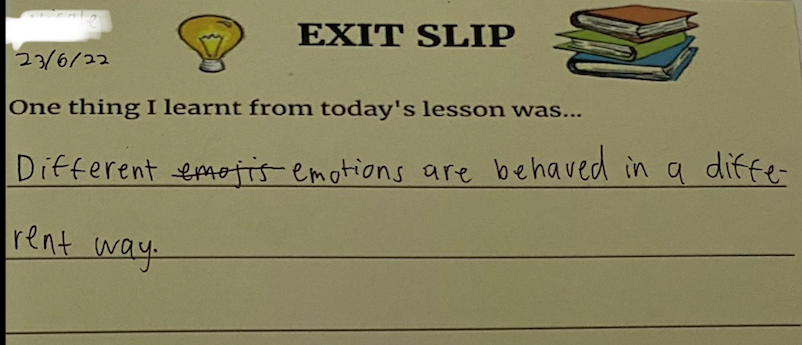
Students Exit Slips completed during the ‘conclusion’ of the lesson.
Bennet & Rolheiser (2001) reinforce that “action without reflection and reflection without action are both unacceptable stances in education” (p.4). Through critical reflection upon my lesson plan, I recognised that I must continuously develop my rapport with students in order to understand the pace at which they learn and utilise the ‘conclusion’ to gauge the effectiveness of my teaching method.
REFERENCES
- Australian Institute for Teaching and School Leadership. (2017). Australian Professional Standards for Teachers. https://www.aitsl.edu.au/standards
- Bennett, B., & Rolheiser, C. (2001). An explanation of mind mapping. Beyond monet: the artful science of ınstructional ıntegration. Toronto: Bookation
- Brookhart, S. M. (2010). How to assess higher-order thinking skills in your classroom. ASCD.
- Butt, G. (2008). Lesson planning 3rd edition. Bloomsbury Publishing.
- Churchill, S., Godinho, S., Johnson, N. F.; Keddie, A., Letts, W.; Lowe, K.; Mackay, J.; McGill, M.; Moss, J.; Nagel, M.; Shaw, K.; Vick, M. (2013). Teaching: Making a difference (3rd ed.). John Wiley & Sons.
- Cicek, V. (2013). Effective use of lesson plans to enhance education. International Journal of Economy, Management and Social Sciences, 2(6), 334-341. https://www.academia.edu/download/55182231/51a9bf32c579f9.28203046.pdf
- Dymoke, S., & Harrison, J. (2008). Reflective teaching and learning. SAGE Publications Ltd.
- Harden, R. M. (2007). Outcome-based education: the future is today. Medical teacher, 29(7), 625-629. https://doi.org/10.1080/01421590701729930
- Leigh, S. R. (2012). The Classroom Is Alive with the Sound of Thinking: The Power of the Exit Slip. International Journal of Teaching and Learning in Higher Education, 24(2), 189-196. https://eric.ed.gov/?id=EJ996265
- NSW Education Standards Authority. (2012). Assessment for, as and of learning. https://educationstandards.nsw.edu.au/wps/portal/nesa/k-10/understanding-the-curriculum/assessment/approaches
- Richards, J. C. (1998). Beyond Training: perspectives on language teacher education. Cambridge: Cambridge University Press.
- Teachings in Education. (2018, January 25). Lesson Planning: What is Required? [Video]. YouTube. https://youtu.be/XPpW9UVb_90
- Trumbull, E., & Lash, A. (2013). Understanding formative assessment: Insights from learning theory and measurement theory. San Francisco: WestEd.
 Holly’s Blog