
As a pre-service teacher and future educator, my teaching philosophy is underpinned by the central notion that all students are entitled to rich, meaningful learning experiences that fosters their full development (Universal Declaration of Human Rights [UDHR], 1948). I believe that this occurs through upholding a ‘safe space’, characterised by acceptance and tolerance and moreover taking into consideration the multifaceted nature of students’ experiences (Australian Institute for Teaching and School Leadership [AITSL], 2017). Students must be assisted with their academic pursuits and social-emotional development through the construction of a strong rapport and positioning the educator as a ‘guide’ rather than a figure whose presence dominates the learning environment (AITSL, 2017 1.1, 1.2, 1.3, 1.4). I believe that adopting a primarily constructivist, humanist and social learning theory approach in the classroom can assist with providing such rich learning experiences to all students. Thus, my teaching ethos has been influenced through my direct involvement in education as both a student and educator, enabling me to understand the obligations of both parties involved in learning.
Constructivist conceptions, with particular reference to Vygotsky (1962), have influenced my understanding of how students learn. As Bada & Olusegun (2015) state, “teachers cannot simply transmit knowledge to students, but students need to actively construct knowledge in their own minds” (p.66). This is reiterated by Churchill et al., (2013) who convey that “the term ‘learner’ in itself implies a degree of agency in the learning process” (p.215). It is integral that the classroom is student-centred, allowing learners to take responsibility for the ‘construction’ of knowledge and skills in order to process new information, understand the world around them and their place within it. It is imperative that I integrate think-pair-share activities, class discussions, debates, inquiry tasks and jig-saw group work in order to accomplish this. Moreover, engagement in such activities aids in developing students’ intrapersonal skills as they are prompted to communicate with peers from diverse backgrounds, exposing them to ‘real world’ practices (Bada & Olusegun, 2015). The framing of the educator as an ‘assistor’ enables students to develop their critical and creative thinking through active experience within the zone of proximal development (Vygotsky, 1978). Learning should not be stagnant and therefore students must be continuously challenged, within reason, in order to prompt movement within the zone of proximal development and maintain engagement (Churchill et al., 2013). Social Learning theory emphasises that the educator plays a vital role in providing effective modelling, practice and opportunities for students to develop their self-efficacy (Bandura, 1976). Through perceiving myself as a ‘facilitator’ of learning, I am able to frame students as active agents in the classroom, involved in constructing their own understanding. However, I also believe that access to assistance is crucial in order for students to strengthen their self-efficacy and reach their full potential. Providing examples of work, demonstrations and prompts/guiding questions can help in providing clarity, assisting students in their attempt to understand key concepts without negating their development within the zone of proximal development (Wood et al., 1976).

PNGWING. (2021). four person reaching out and jigsaw puzzle illustration. https://www.pngwing.com/en/free-png-zdeyb 
Clipart Library. (2019). Globe. http://clipart-library.com/globe-cliparts.html
All students are unique and I must take this into consideration as I structure and deliver lessons (AITSL, 2017, 1.3). I believe in adopting a Universal Design for Learning approach in order to develop my student-teacher rapport, cater for students’ interests and differentiate for diverse learners (Craig et al., 2022, AITSL, 2017, 1.1, 1.2, 1.3, 1.4, 1.5 and 1.6). Ultimately, a learner-centred classroom is of paramount importance, enabling students to recognise their capabilities as critical and creative individuals, reaching a point of ‘self-actualisation’ (Crain, 2015). Influenced by humanist theoretical concepts, this aspect is reinforced within my teaching ethos. Maintaining an inclusive, engaging classroom environment is held in high regard in order to ensure students’ physical, psychological, social-emotional and academic needs are not neglected (Maslow, 1943). I believe that providing variance in class work, offering students time to self-reflect, engage in collaboration and receive positive feedback/reinforcements are crucial steps I can take in order to develop my rapport with students and increase their desire to engage in learning. Maslow (1970) attests that “there are no perfect human beings” (p. 176) and therefore ‘self-actualisation’ does not inherently perceive students becoming ‘perfect’ but rather recognising themselves as strong, capable individuals with drive and purpose. Thus, it is my responsibility to ensure that all students are provided with opportunities to strengthen their self-efficacy, as indicated within Maslow’s Hierarchy of Needs (Maslow, 1943).
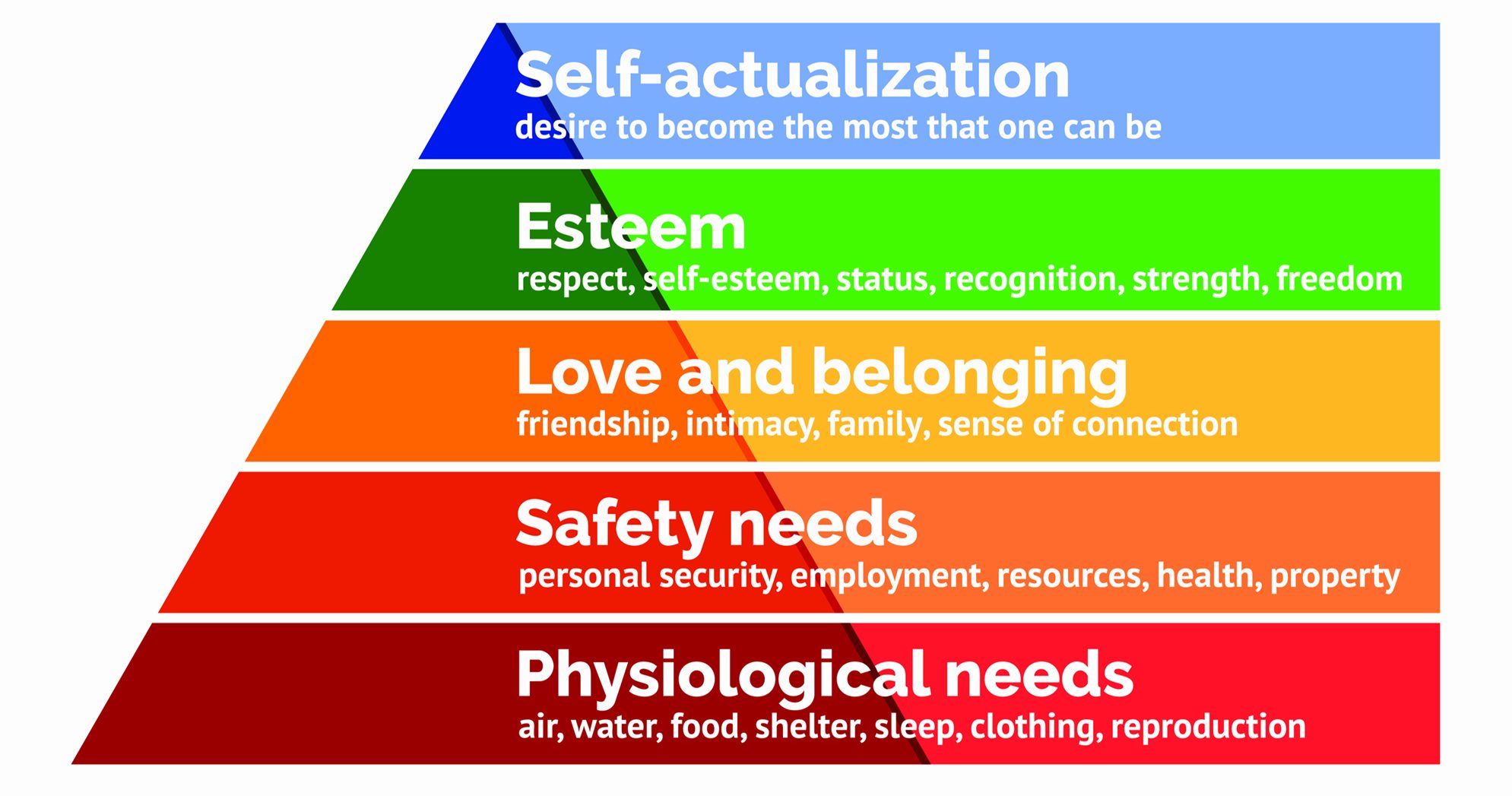
SimplyPsychology. (2007). Maslow’s Hierarchy of Needs. https://www.simplypsychology.org/Maslows-Hierarchy-of-Needs.jpg
Colin. P-V. (2019, November 28). Freedom Writers 2007, Line game scene [Video]. YouTube. https://www.youtube.com/watch?v=CCrEn1PVdHg
As stipulated by AITSL (2017), “teachers share a significant responsibility in preparing young people to lead successful and productive lives” (p.2). My teaching philosophy involves sharing my passion for learning with students whilst maintaining that I am a ‘facilitator’, providing opportunities for students to develop lifelong skills that are utilised beyond the classroom context. I must continue to be a reflective educator in a continuously evolving profession, listening to feedback, applying it and engaging in professional development, ensuring that I do not remain stagnant in my practices and attitude.
REFERENCES
- Australian Institute for Teaching and School Leadership. (2017). Australian Professional Standards for Teachers. https://www.aitsl.edu.au/standards
- Bada, S. O., & Olusegun, S. (2015). Constructivism learning theory: A paradigm for teaching and learning. Journal of Research & Method in Education, 5(6), 66-70. DOI: 10.9790/7388-05616670
- Clipart Library. (2019). Globe. http://clipart-library.com/globe-cliparts.html
- Colin. P-V. (2019, November 28). Freedom Writers 2007, Line game scene [Video]. YouTube. https://www.youtube.com/watch?v=CCrEn1PVdHg
- Crain, W. (2015). Theories of development: Concepts and applications. Routledge.
- Maslow, A. H. (1943). A theory of human motivation. Psychological Review, 50(4), 370-96.
- Maslow, A. H. (1970). Motivation and personality. New York: Harper & Row.
- PNGWING. (2021). four person reaching out and jigsaw puzzle illustration. https://www.pngwing.com/en/free-png-zdeyb
- SimplyPsychology. (2007). Maslow’s Hierarchy of Needs. https://www.simplypsychology.org/Maslows-Hierarchy-of-Needs.jpg
- United Nations. (1948). Universal Declaration of Human Rights. https://www.un.org/en/about-us/universal-declaration-of-human-rights
- Vygotsky, L. S. (1978). Mind in society: The development of higher psychological processes. Cambridge, MA: Harvard University Press.
- Wood, D., Bruner, J., & Ross, G. (1976). The role of tutoring in problem solving. Journal of Child Psychology and Child Psychiatry, 17, 89−100. https://doi.org/10.1111/j.1469-7610.1976.tb00381.x
 Holly’s Blog
