
CLASSROOM & BEHAVIOUR MANAGEMENT
Educators maintain duty of care within educational contexts, that is, to ensure that the learning environment is safe, supportive and fosters all students development (NSW Department of Education, 2021). I strive to ensure I maintain duty of care whilst on placement, especially as students learn through practical involvement, in order to promote student engagement and access to meaningful learning that is not hindered by disruptiveness, recklessness and the inability to provide a ‘safe space’ (AITSL, 2017, 1.6, 3.3, 3.5, 4.1, 4.2, 4.3 and 4.4).
INCIDENT
I introduced the topic of ‘drama’ to my Year 9 English class through a warm-up game of charades prior to delving into in-depth study. Students remained in their table groups (groups of 4) and were each handed a scenario to act out to the peers in their group. I instructed them to act out each scenario SILENTLY, using only their facial expressions and hand gestures. However some students did not adhere to these instructions as they moved to different groups, used inappropriate language at times and were not respecting their peers.

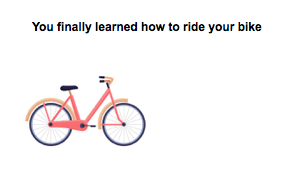
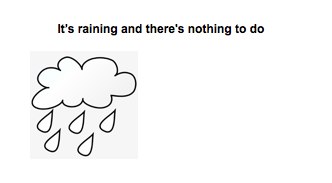
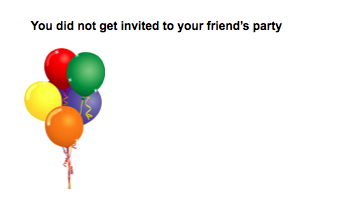
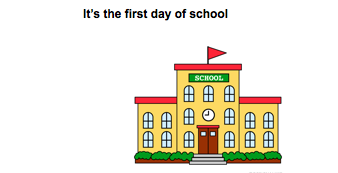
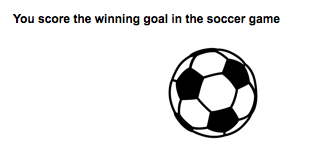
Charades cards given to students for the ‘warm up’ task
Prior to commencing the activity, I provided clear instructions concerning the intention of the warm-up, indicated that I would award demerits if students behaved inappropriately and developed three important classroom expectations that were required to be upheld by ALL students:
- Technology is a tool, not a toy
- Listen to instructions with your ears, eyes and mouths
- Treat others how you want to be treated
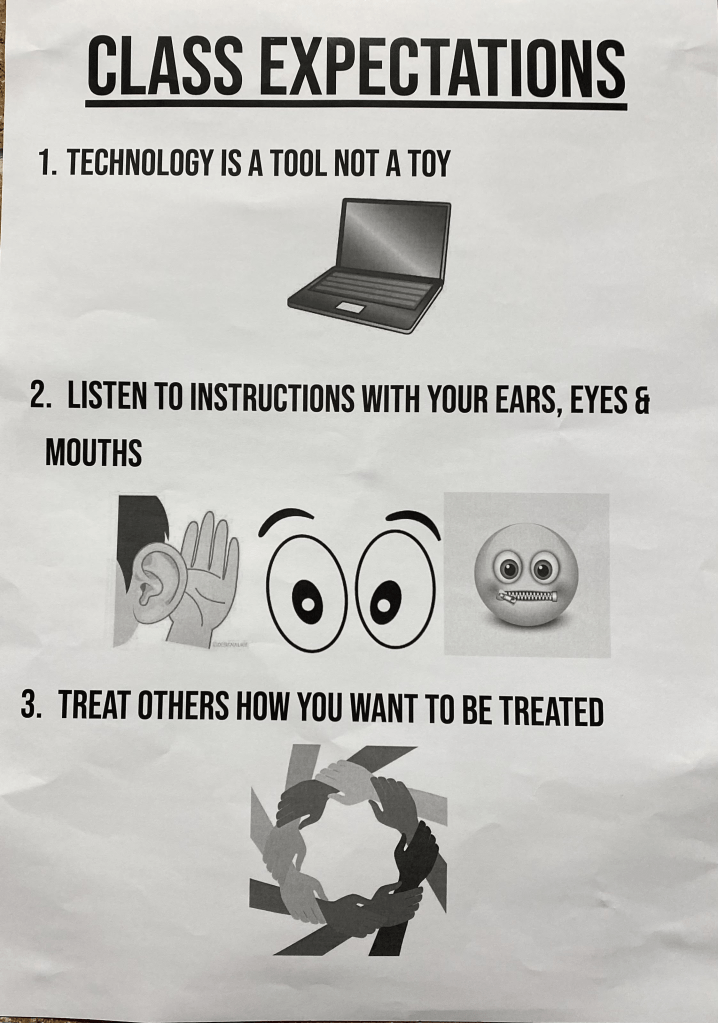
Classroom expectations printed and placed around the classroom
It was crucial that I clarified classroom expectations 2 and 3 immensely prior to commencing this activity in order to minimise disruption and misbehaviour and ultimately promote a safe learning environment (AITSL, 2017, 4.2, 4.3, 4.4).
Although I established the requirements of student behaviour, such verbal explanation was not entirely effective. I was inclined to stop the activity and engage in discussion concerning the class expectations and students’ misbehaviour. This discussion was student-centred as I invited students to discuss how each expectation appears in practice i.e. What instruction did I give prior to beginning the activity? What does it mean to treat others how you want to be treated? The ‘Responsible Thinking Process’ underpinned my actions towards this incident as it fosters teaching students to think responsibly, be held accountable for their actions and understand how they can respect all individuals in the classroom including the educator and their peers (Ford, 1994). I believe this was an effective way to combat the situation as it ensured students understood that the classroom is a place for learning and such misbehaviour would not be tolerated. I maintain that I must continuously clarify expectations at the start of each lesson in order to maintain consistent practice. Whilst I had intended to address misbehaviour through awarding demerits, I gave three warnings instead and it was through critical reflection that I should have aligned my practice with the original intended consequence in order to maintain consistency in method. Such act aligns itself with the Behavioural Learning Theory, in particular, a form of operant conditioning posed by Skinner in order to reduce the likelihood of students misbehaving in the classroom in subsequent lessons (Skinner, 1938). Upon further reflection, I could have provided positive reinforcements i.e. merits in order to reward students/groups that listened to instructions, worked well and completed the activity in the shortest amount of time (Skinner, 1938). Such positive feedback assists in enhancing students self-esteem and helps develop a better student-teacher relationship (Churchill et al., 2013). Moreover, if students are to engage in collaborative tasks, allocating groups effectively i.e. pre-assigned, assigning each student a number or completion in pairs would assist in minimising disruption (Churchill et al., 2013). Building a rapport with students is critical as it can aid in sustaining a classroom that features order and discipline, building a positive teacher-student relationship (Canter, 2010). This also includes developing my ‘teacher voice’ in order to correct disruptive behaviour, establishing a degree of assertive discipline (Canter, 2010).

Cliparts Zone. (2016). Advantage. https://cliparts.zone/img/549644.jpg
I believe these are aspects within my teaching practice that I can develop in order to effectively address challenging behaviour in the future and establish a safe, learning environment.
REFERENCES
- Australian Institute for Teaching and School Leadership. (2017). Australian Professional Standards for Teachers. https://www.aitsl.edu.au/standards
- Canter, L. (2010). Assertive discipline: Positive behavior management for today’s classroom. Bloomington: Solution Tree Press.
- Churchill, S., Godinho, S., Johnson, N. F.; Keddie, A., Letts, W.; Lowe, K.; Mackay, J.; McGill, M.; Moss, J.; Nagel, M.; Shaw, K.; Vick, M. (2013). Teaching: Making a difference (3rd ed.). John Wiley & Sons.
- Cliparts Zone. (2016). Advantage. https://cliparts.zone/img/549644.jpg
- Ford, E. E. (1994). Discipline for home and school: Teaching children to respect the rights of others through responsible thinking based on perceptual control theory. Brandt Publications.
- NSW Department of Education. (2021). Employee responsibility. https://education.nsw.gov.au/about-us/rights-and-accountability/department-of-education-code-of-conduct/employee-responsibility
- Skinner, B. F. (1938). The Behavior of organisms: An experimental analysis. New York: Appleton-Century.
 Holly’s Blog
