
ICT FOR TEACHING AND LEARNING
The use of Information Communication Technology (ICT) in both the teaching and learning cycle has become influential, integrated within pedagogical paradigms to support accessibility and engagement (Churchill et al., 2013). It has maintained the power to guide engagement, catalyse interest in content, develop interpersonal/intrapersonal skills and differentiate activities to suit diverse learners (Roach, 2014). The successful integration of ICT within educational context, however, is largely dependent on the educators ability to incorporate it meaningfully (UNESCO, 2008) and thus consideration of AITSL Standards 1.3, 1.5, 3.4, 4.1, 4.5, 5.1, 5.2 and 5.4 (2017) prior to facilitating learning through the use of ICT proved to be critical in transforming learning for students.
Within my Year 9 English lesson, I utilised the interactive platform ‘padlet’ in order to support my teaching practice and promote student engagement (Mehta et al., 2021). Reflection upon these standards and consideration of the benefits of a constructivist approach ensured that students would be actively involved in ‘constructing’ knowledge in a new dimension (Vygotsky, 1978). It was thus used as a means of ‘augmentation’ as illuminated through the SAMR model, acting as a direct substitute which provided improvement to student learning (Romrell et al., 2014). Padlet was used effectively as students composed a book review concerning their set novel study, commented on peers’ reviews to provide feedback and ultimately engaged in practices that align with Vygotsky’s Constructivist theory and the intentions of the SAMR model. It is integral for students to share their insights, demonstrate active thinking, examine various viewpoints and ‘expose’ them to review as this results in the development of higher order thinking and strengthens students’ sense of self-efficacy (Jones, 2008, Bada & Olusegun, 2015, Maslow, 1943). Padlet provided an anonymous, alternate form of learning for students to ‘voice’ their opinions, critical for students in my class with anxiety disorders as they were actively engaged in the activity (Pollock, 2016, McDowell et al., 2019). Moreover, Fuchs (2014) asserts that students may be reluctant to share opinions as they fear speaking in public environments and may perceive their opinions not to be well-informed. Thereby, ‘padlet’ was used in this context in order to develop student engagement and self-esteem prior to engaging in future collaborative in-person tasks. Rather than students providing feedback orally to peers, responding in the form of a ‘comment’ decreased time spent on this section of the lesson and enabled students to focus their attention on the consolidation of understanding (Fisher, 2017). Additionally, such peer interactions aid in the development of interpersonal skills, necessary for students to communicate effectively in written form, feel involved in the learning environment and build their confidence (Romrell et al., 2014).
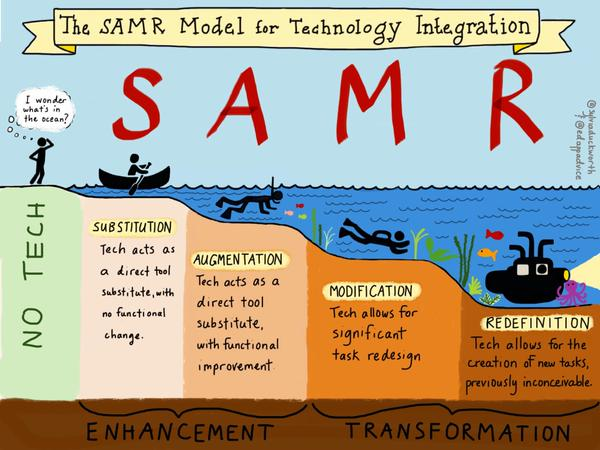
Auburn School Department. (2022). SAMR Model. https://cdn5-ss20.sharpschool.com/UserFiles/Servers/Server_219555/Image/Departments/Technology%20Team/Tech%20Tools%20for%20Teachers/SAMR%20Model/SAMR%20Model%20Technology.jpg
Upon collection of student data, I recognised that whilst many students engaged well with expressing their opinions through their reviews, not all students were involved in the activity. This may have stemmed from the lack of access to devices i.e. students had to share and take turns posting or write their reviews in their books in order to post at a later time (AITSL, 2017, 1.3), some students lack of familiarity with the novel due to it being a mixed-ability classroom, lack of interest in the novel or continual fear of having their work posted on an online platform despite it being anonymous (Churchill et al., 2013). Moreover, most students did not provide constructive feedback to peers, gave a simple one-word positive comment and used the activity as a means to communicate with peers ‘socially’. Thus, clarification on the ethical use of ICT, discussion regarding the importance of providing appropriate feedback, assigning student names to comments in order to hold students accountable (Ford, 1994) and monitoring/projecting students answers and comments frequently could have aided in upholding AITSL standards 2.6 and 4.5 (2017).

Ultimately, ICT was implemented in order for students to practice expressing their opinions and providing feedback to peers. With particular reference to standards 2.6, 3.4 and 4.5, educators are called to consider how ICT can enhance students’ engagement with curriculum content, act as a means of differentiation and be utilised effectively through maintaining ‘duty of care’ (AITSL, 2017). I believe that I can strengthen my ability to uphold these standards in future practice through clarifying the use of ICT as an educational tool and providing explicit instruction to inform learning.
REFERENCES
- Auburn School Department. (2022). SAMR Model. https://cdn5ss20.sharpschool.com/UserFiles/Servers/Server_219555/Image/Departments/Technology%20Team/Tech%20Tools%20for%20Teachers/SAMR%20Model/SAMR%20Model%20Technology.jpgAustralian Institute for Teaching and School Leadership. (2017). Australian Professional Standards for Teachers. https://www.aitsl.edu.au/standards
- Bada, S. O., & Olusegun, S. (2015). Constructivism learning theory: A paradigm for teaching and learning. Journal of Research & Method in Education, 5(6), 66-70. DOI: 10.9790/7388-05616670
- Churchill, S., Godinho, S., Johnson, N. F.; Keddie, A., Letts, W.; Lowe, K.; Mackay, J.; McGill, M.; Moss, J.; Nagel, M.; Shaw, K.; Vick, M. (2013). Teaching: Making a difference (3rd ed.). John Wiley & Sons.
- Fisher, C. (2007). Padlet: An Online Tool for Learner Engagement and Collaboration. Academy of Management Learning & Education, 16(1). https://doi.org/10.5465/amle.2017.0055
- Ford, E. E. (1994). Discipline for home and school: Teaching children to respect the rights of others through responsible thinking based on perceptual control theory. Brandt Publications.
- Fuchs, B. (2014). The writing is on the wall: using Padlet for whole-class engagement. Loex Quarterly, 40(4), 7. https://uknowledge.uky.edu/cgi/viewcontent.cgi?article=1241&context=libraries_facpub
- Jones, R. C. (2008). The “why” of class participation: A question worth asking. College Teaching, 56(1), 59-63. http://www.tandfonline.com/loi/ vcol20#.U2PoEFdcw60
- Maslow, A. H. (1943). A theory of human motivation. Psychological Review, 50(4), 370-96.
- Mehta, K. J., Miletich, I., & Detyna, M. (2021). Content-specific differences in Padlet perception for collaborative learning amongst undergraduate students. Research in Learning Technology, 29. https://doi.org/10.25304/rlt.v29.2551
- McDowell, A., Cutting, D., Sage, P., Allen, A., & McGowan, A. (2019). Backchannel in large learner cohorts – does anonymity matter? A comparative study. Education and Information Systems, Technologies and Applications. Orlando, United States.
- Pollock, M. (2016). Smart Tech Use for Equity. The Education Digest, 81, 40-45. https://search.proquest.com/docview/1768622785?accountid=14723
- Roach, T. (2014). Student perceptions toward flipped learning: New methods to increase interaction and active learning in economics. International Review of Economics Education, 17, 74-84. https://doi.org/https://doi.org/10.1016/j.iree.2014.08.003
- Romrell, D., Kidder, L., & Wood, E. (2014). The SAMR model as a framework for evaluating mLearning. Online Learning Journal, 18(2). https://www.learntechlib.org/p/183753/.
- UNESCO. (2008). ICT Competency Standards for Teachers: Implementation Guidelines. http://unesdoc.unesco.org/images/0015/00156209E.pdf.
- Vygotsky, L. S. (1978). Mind in society: The development of higher psychological processes. Cambridge, MA: Harvard University Press.
 Holly’s Blog
