
Greenhow et al. (2022) note that the rise of COVID-19 greatly impacted the form in which learning takes place, being that ‘face to face’ became ‘screen to screen’. Despite presenting opportunities to learn in a new manner, Martin et al. (2020) suggest that a lack of familiarity with online learning can decrease learner engagement as ‘traditional’ practices may not effectively support learners in different contexts. It is vital to consider Salmons’ ‘Five Stage Model’ and critically reflect upon how educators and students play a pivotal role in facilitating effective, inclusive learning in the online domain. This model understands online learning as a gradual process, involving “intricate and complex interaction between neural, cognitive, motivation, affective and social processes” (Azevedo, 2002, p.31). These processes work together in a synchronous manner in order to establish an online learning space reflective of an inclusive ‘community of practice’ (Greenhow et al., 2022). Such communities are created through educators and students engaging in collective learning that encourages active communication and participation (Smith, 2009). Thus, consideration of ‘netiquette’ is crucial as progression within each stage and the development of all the aforementioned processes is contingent upon establishing a safe, respectful online environment (Teaching Online, 2014).
Dr R. Yeap. (2021, August 1). Salmon 5-stage model (by Professor Gilly Salmon) [Video]. YouTube. https://youtu.be/ckzlnXFncNo
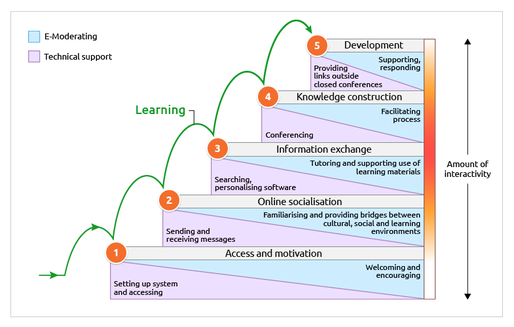
Gilly Salmon. (2022). The Five Stage Model.
This is of particular importance with regard to involvement in Stage 2, ‘online socialisation’, as learning is not an isolated, passive process. It requires individuals working together, ‘expressing’ themselves and their understanding in order to strengthen their self-awareness and processes as an online learner (Salmon, 2011). The establishment of a welcoming online community of practice has motivated me to contribute to both written and verbal discussion, progressing from Stage 1 to 2 (Salmon, 2011). As a student, I acknowledged how it was critical for the educator to encourage rather than force direct communication, ultimately ‘creating’ invested learners.
REFERENCES
Azevedo, R. (2002). Beyond intelligent tutoring systems: Using computers as METAcognitive tools to enhance learning?. Instructional Science, 30(1), 31-45. https://link.springer.com/article/10.1023/A:1013592216234
Dr R. Yeap. (2021, August 1). Salmon 5-stage model (by Professor Gilly Salmon) [Video]. YouTube. https://youtu.be/ckzlnXFncNo
Framroze, M. (2017). Self-spectacle online: The construction and representation of identity in contemporary digital culture. UCLA.
Gilly Salmon. (2022). The Five Stage Model. https://www.gillysalmon.com/uploads/5/0/1/3/50133443/1617139.png?515
Greenhow, C., Graham, C. R., & Koehler, M. J. (2022). Foundations of online learning: Challenges and opportunities. Educational Psychologist, 57(3), 131-147. https://doi.org/10.1080/00461520.2022.2090364
Martin, F., Stamper, B., & Flowers, C. (2020). Examining Student Perception of Readiness for Online Learning: Importance and Confidence. Online Learning, 24(2), 38-58. https://eric.ed.gov/?id=EJ1260328
Salmon, G. (2011). E-moderating: The key to Teaching and Learning Online (3rd ed.) London: Routledge.
Smith, M. (2003). Jean Lave, Etienne Wenger and communities of practice. http://infed.org/mobi/jean-lave-etienne-wenger-and-communities-of-practice/
Teaching Online. (2014). Course netiquette and guidelines. https://leocontent.acu.edu.au/file/ccbe60fc-4a3c-4a2c-a80e-286a4946a9f3/1/html/ote_2_30.html
 Holly’s Blog