Learning is a lifelong process, intrinsically connected to all human practices and therefore “when we fail to take control of our education, we fail to take control of our lives” (Hayes, 1998, p.14).
Churchill et al. (2013) associate the term ‘learner’ with notions of ‘agency’ and ‘autonomy’, positioning learning as a student-centred ‘activity’. Within the ‘personal learning space’, students’ must be granted an element of control in order to reconnect with and develop their internal processes, feel a part of the ‘community of practice’ and develop their self-efficacy.
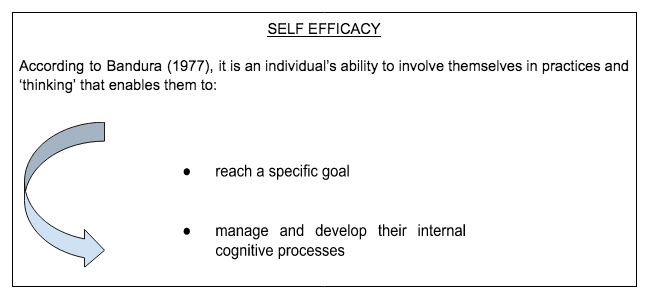
The Education Hub. (2019, August 29). Self Efficacy Animation. [Video]. YouTube. https://www.youtube.com/watch?v=H7GbHIZBRWY
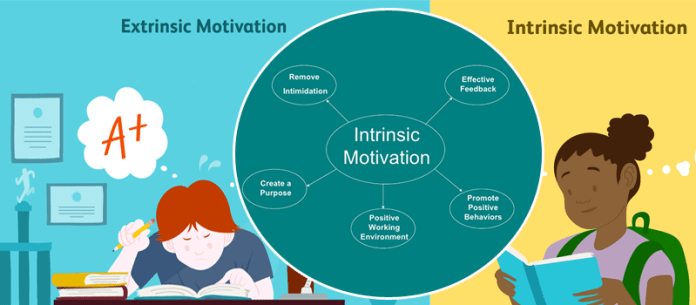
Learners’ participate in an activity, develop their interest, commit to it and view ‘set-backs’ as tasks yet to be mastered rather than disappointments (Bandura, 1977). Whilst the provision of extrinsic motivation can motivate learners to achieve goals, it does not aid in strengthening their self-efficacy as it can distract them from investing their time into continuous, effortful learning (Pew, 2007). I believe it is critical to encourage learners to be ‘proactive’ rather than entirely ‘reactive’ (Knowles, 1975).

Opennaurki. (2020). Intrinsic vs Extrinsic Motivation: How To Stay Motivated All The Time. https://i2.wp.com/d3d2ir91ztzaym.cloudfront.net/uploads/2020/11/Intrinsic-vs-Extrinsic-Motivation.png?resize=696%2C305&ssl=1
How? The ‘personal’ learning space at Candlebark School invited me to consider how I, as an educator, can:
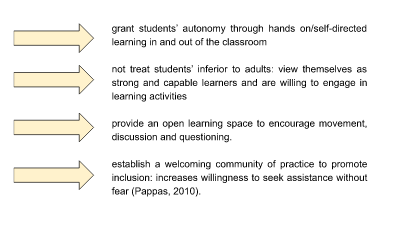
SBS The feed. (2015, March 27). John Marsden’s Happy School. [Video]. YouTube https://www.youtube.com/watch?v=FuIyOZ2jHlY
It is also crucial to promote self-reflection, for example, the use of a KWL chart (Churchill et al., 2013) as students consider their involvement in activities, their attitude and response, and take gradual steps to achieve goals (Merriam & Caffarella, 1991).
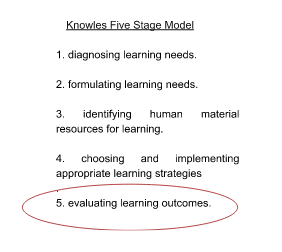

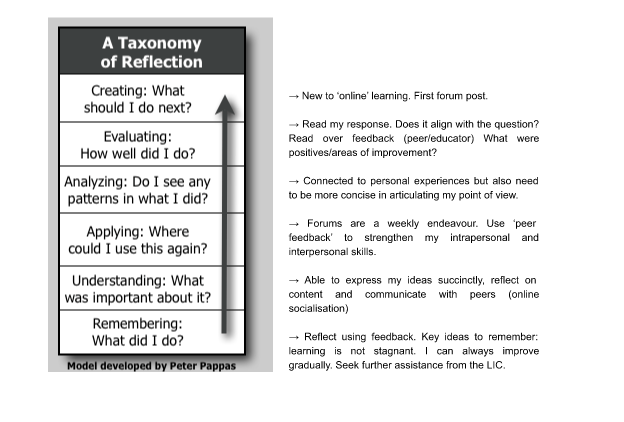
The development of my ‘personal’ learning in EDFD459
REFERENCES
Bandura, A (1977). Self-efficacy: Toward a Unifying Theory of Behavioral Change. Psychological Review. 84 (2): 191–215. https://doi.org/10.1037/0033-295X.84.2.191
Churchill, S., Godinho, S., Johnson, N. F.; Keddie, A., Letts, W.; Lowe, K.; Mackay, J.; McGill, M.; Moss, J.; Nagel, M.; Shaw, K.; Vick, M. (2013). Teaching: Making a difference (3rd ed.). John Wiley & Sons.
Hayes, C. (1998) Beyond the American Dream. Lifelong learning and the search for meaning in a postmodern world, Wasilla: Autodidactic Press.
Knowles, M. (1975). Self-Directed Learning. A guide for learners and teachers. Englewood Cliffs: Cambridge.
Merriam, S. B. and Caffarella, R. S. (1991). Learning in Adulthood. A comprehensive guide. San Francisco: Jossey-Bass.
Pappas, P. (2010). The Reflective Student: A Taxonomy of Reflection (Part 2). http://peterpappas.com/2010/01/reflective-student-taxonomy-reflection-.html
Pew, S. (2007). Andragogy and Pedagogy as Foundational Theory for Student Motivation in Higher Education. Student Motivation, 2, 17-18.
 Holly’s Blog