
“Real learning requires stepping into the unknown, which initiates a rupture in knowing” (Schwartzman, 2010, p.38)
This ‘rupture’ underpins the ‘liminal’ learning space. Learners are beckoned to accept that they are within the unknown and untether themselves from prior understandings. In order for change to be ‘transformative’ and ‘progressive’, learners experience a “deep, structural shift in…thought, feelings and actions…a shift of consciousness that dramatically and irreversibly alters our way of being in the world” (O’Sullivan et al., 2022, p.11).
TEDx Talks. (2019, August 22). Liminal Spaces | Sarah Sawin Thomas | TEDxLincoln. . YouTube. https://www.youtube.com/watch?v=HWlKLhJW_P8
Ross (2011) views this process as ‘re-authoring’ and I am inclined to agree given that being within the liminal prompts learners to critically reflect upon cognitive processes and establish themselves in the post-liminal with new insights.
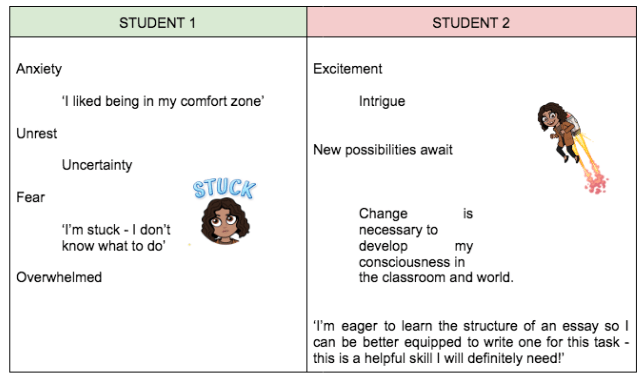
Learners can react differently within the liminal space through being confronted with new concepts and skills to develop.
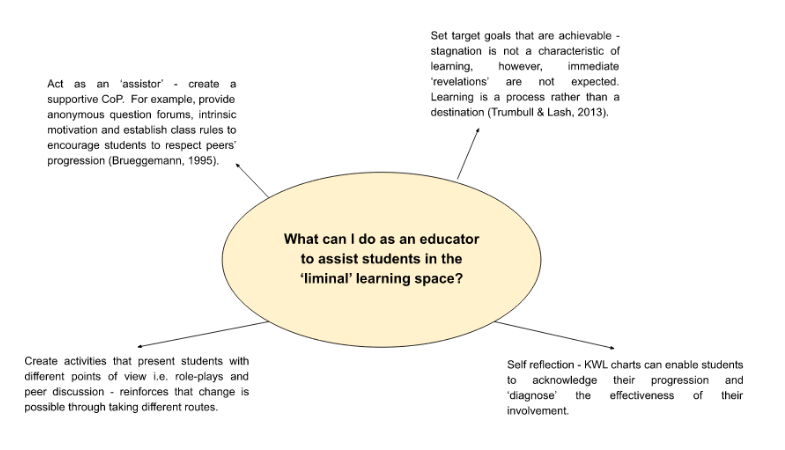
These practices create an environment whereby critical reflection and questioning of ‘normalities’ is not only supported by actively encouraged (Land et al., 2014).
Personally, I have been within the liminal space as I progressed from Stage 5 to 6 in High School or transferred courses at University. Support and provision of a ‘safe space’ was crucial to navigate the ambiguity created by life’s uncertainties and progress without overwhelming pressure to be ‘transformed’ instantly.

REFERENCES
Brueggemann, W. (1995). Preaching as reimagination. Theology Today, 52(3), 313-329.
Land, R., Rattray, J. & Vivian, P. (2004). Learning in the liminal space: a semiotic approach to threshold concepts. High Educ 67, 199–217. https://doi.org/10.1007/s10734-013-9705-x
O’Sullivan, E. (2002). The project and vision of transformative education. In E. O’Sullivan, A. Morrell, & A. O’Connor (Eds.), Expanding the boundaries of transformative learning (pp. 1–12). New York: Palgrave.
Schwartzman, L. (2010). Transcending disciplinary boundaries: A proposed theoretical foundation for threshold concepts. In R. Land, J. Meyer, and C. Baillie, (Ed.s), Threshold concepts and transformational learning. (21-44). Rotterdam, Netherlands: Sense Publishers
TEDx Talks. (2019, August 22). Liminal Spaces | Sarah Sawin Thomas | TEDxLincoln. . YouTube. https://www.youtube.com/watch?v=HWlKLhJW_P8
Trumbull, E., & Lash, A. (2013). Understanding formative assessment: Insights from learning theory and measurement theory. San Francisco: WestEd.
 Holly’s Blog