
‘Learning to learn online’ has been a gradual, non-linear process. During the completion of the unit EDFD459, Learning Spaces, the educator and I have been “separated” by “time” and “distance” (Dempsey & Van Eck, 2002, p. 283), two key aspects which can influence investment in effective online learning. At first, I found myself within the ‘liminal’, uncertain about the content or tasks I would encounter and hesitant to ‘express’ myself given that the internet lives forever. However, the establishment of a supportive community of practice (Smith, 2003) enabled me to progress from Stage 1 to 2 ‘Online Socialisation’, contributing to written and verbal discussion, and now I reside in Stage 4 ‘Knowledge Construction’ (Salmon, 2011).
Link to my first post – ARTICLE 1 – LEARNING TO LEARN ONLINE
How did I progress?
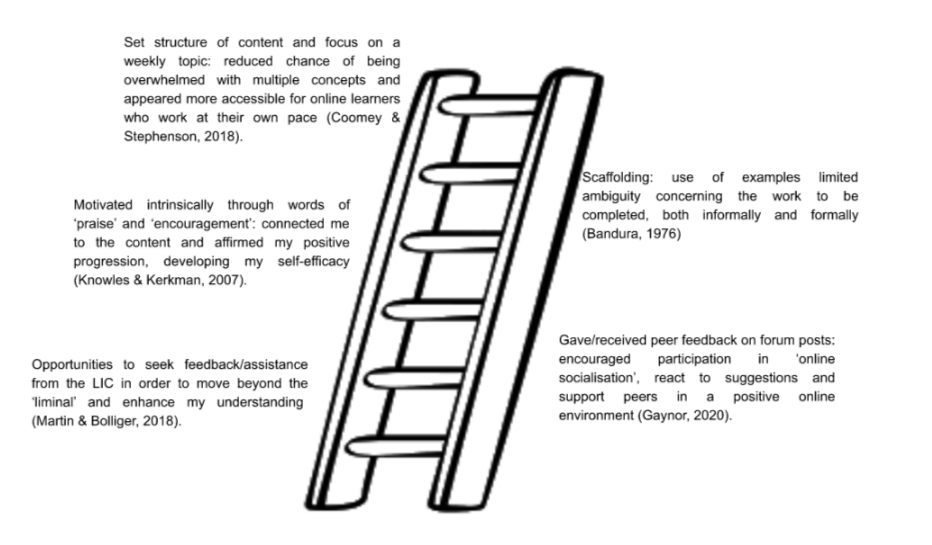
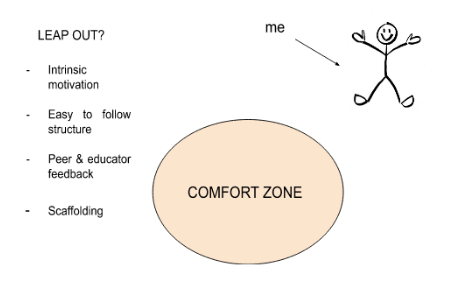
I was able to ‘leap’ out of my comfort zone through the establishment of these practices. As an educator, I endeavour to consider that students require extra assistance in the online realm as there is a physical separation between the teacher and learner. Establishing a supportive CoP underpins my teaching ethos as it is the first step to encourage effortful learning.

REFERENCES
Bandura, A (1977). Self-efficacy: Toward a Unifying Theory of Behavioral Change. Psychological Review. 84 (2): 191–215. https://doi.org/10.1037/0033-295X.84.2.191
Coomey, M., & Stephenson, J. (2018). Online learning: It is all about dialogue, involvement, support and control—according to the research. In Teaching & learning online (pp. 37-52). Routledge.
Dempsey, J. V., & Van Eck, R. N. (2002). Instructional design on-line: Evolving expectations. Trends and issues in instructional design and technology, 281-294.
Gaynor, J. W. (2020). Peer review in the classroom: Student perceptions, peer feedback quality and the role of assessment. Assessment & Evaluation in Higher Education, 45(5), 758-775.
Knowles, E., & Kerkman, D. (2007). An investigation of students’ attitude and motivation toward online learning. InSight: A Collection of Faculty Scholarship, 2, 70-80.
Martin, F., & Bolliger, D. U. (2018). Engagement matters: Student perceptions on the importance of engagement strategies in the online learning environment. Online Learning, 22(1), 205-222.
Salmon, G. (2011). E-moderating: The key to Teaching and Learning Online (3rd ed.) London: Routledge.
Smith, M. (2003). Jean Lave, Etienne Wenger and communities of practice. http://infed.org/mobi/jean-lave-etienne-wenger-and-communities-of-practice/
 Holly’s Blog