Evidence
Critical Reflection
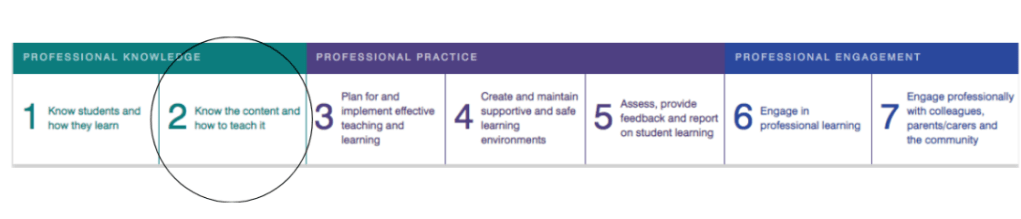
APST 2 is concerned with the content that educators are expected to teach students. Specifically, focus area 2.2 emphasises that educators must consider how to effectively organise content in the teaching and learning cycle in order to engage in meaningful learning experiences (AITSL, 2017). The evidence I have provided for APST 2.2 reflects the integration of the cross-curriculum priority (CCP), Asia & Australia’s Engagement with Asia as well as the General Capabilities (GC); Intercultural Understanding, Personal and Social Capability and ICT (ACARA, n.d.).
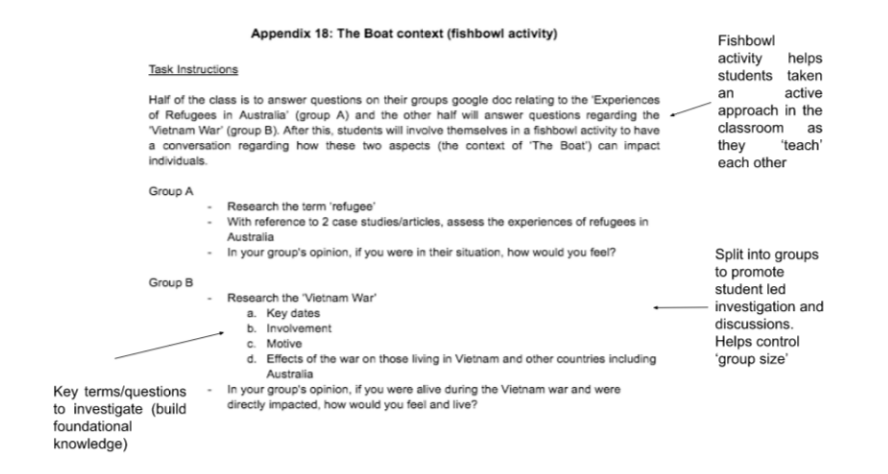
‘The Boat Context – Fishbowl activity) was created as an activity for senior students, as part of a university assessment, to complete in order to develop their contextual understanding prior to engaging in further learning. Rather than focusing on providing a ‘textbook’ definition of refugees experiences in Australia and the Vietnam War, I constructed this task to demonstrate how it is more effective for students to engage in inquiry learning, collaboratively. The aforementioned CCP is reflected within this English task as ACARA (n.d.) states, “students can explore and appreciate the diverse range of traditional and contemporary texts from and about the peoples and countries of Asia, including texts written by Australians of Asian heritage” . The multimodal adaptation of Nam Le’s text, ‘The Boat’ by Matt Huynh acts as the focus text upon which students are conducting their investigation. It features the harrowing experiences of individuals seeking refuge in Australia during the Vietnam War (Le, 2009). Thus, this activity would simultaneously illuminate the experiences of the Asian community, foregrounded within this CCP, and strengthen students’ intercultural Understanding, a prominent GC. This GC encompasses recognising cultures, developing empathy and respect towards them. Through the evidence provided, it is clear that students develop their understanding of how contextual factors can influence authors’ storytelling and communication of their experience. Thus, this aids in bolstering students’ intercultural understanding and becoming informed, active citizens. Additionally, interaction with the GC ‘ICT’ and ‘Personal and Social Capability’ is apparent through students working collaboratively on a google doc, answering set questions and engaging in discussion regarding their findings. This further enables students to develop their sense of self-efficacy, maintain themselves as active learners and limits engagement in passive learning (Kesler et al., 2022).
Ultimately, content was considered and organised in an effective way, as illuminated within APST 2.2, in order for students to engage in meaningful learning and interact with the CCP and GC’s mentioned.
 Holly’s Blog