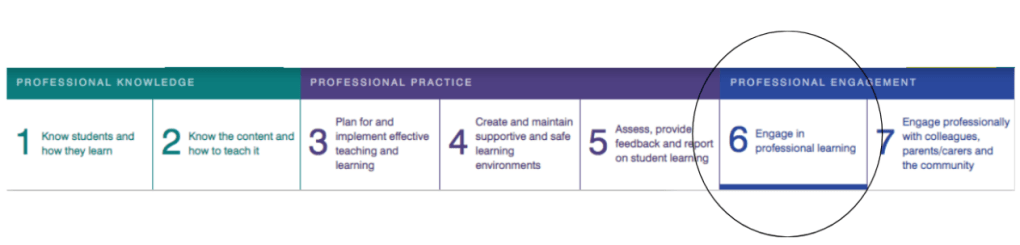
Included within the Australian Professional Standards for Teachers, APST 6 is focused upon professional engagement. Specifically, it elucidates how educators are required to engage in professional learning in order to provide optimal learning experiences (AITSL, 2017, 6.1, 6.2, 6.3 & 6.4). Through such professional development, educators are able to differentiate learning so that it caters for all students and reflects best practice. It is thereby a learning experience for educators as they adjust their mindset and practice to reflect inclusivity, achieve success through collaboration and integrate resources that enhance learning. As a pre-service educator, I aim to continually renew my understanding of ‘professional learning’. The education profession is constantly evolving and therefore practice must adapt to the ever-changing demands of our context.
An area that I believe requires further development, given that I have not encountered many opportunities to strengthen this, is how I interact with parents/caregivers, reflected within APST 3.7.
It can often be difficult to formulate a strong, positive rapport with caregivers/parents and maintain it throughout the duration of the school year. Reflection upon this can enable me to monitor how often I email, call or meet with parents/caregivers to engage in two-way conversation regarding the social, emotional and academic development of their child. NSW Department of Education’s ‘Parent and Carer Engagement Framework’ lists 5 principles of effective engagement including: ‘give me access’, ‘communicate with me openly’, ‘partner with me’, ‘understand my situation’ and ‘guide my choices’ (NSW Government, 2023). Such framework can enable APST 6.4 to be achieved as it allows professional development to occur, altering my perception of engagement with parents/caregivers and ensuring everyone is ‘on the same page’ regarding their childs’ development.
Moreover, asking for feedback from supervisors or other staff can help me understand areas which may require further development. It is an opportunity that should not be perceived as ‘degrading’ or an ‘attack’ on my professional abilities but rather my desire to be the best educator I can be through taking constructive criticism. Collaboration with colleagues is also imperative as each individual bears a unique perspective, scaffolded through their respective experiences. Sharing resources, whether in person or digitally, for example through joining social media groups i.e. NSW English Discussion Group can enable us to have a vast array of work that caters for a range of learners and formulate a strong professional network.



 Holly’s Blog