
Overview of Standard
APST 1 requires the educator to understand the context of their class, that is, each learners’ background, specific learning abilities, needs and manner in which they learn most effectively. Specifically, this enables students with diverse needs as well as Aboriginal and Torres Strait Islander Students to receive tailored care that promotes their inclusion in the learning process. Through this, the educator is able to provide optimal learning experiences that lead to students’ full development as a learner and individual.
Evidence: 1.5 – Differentiate teaching to meet the specific learning needs of students across the full range of abilities
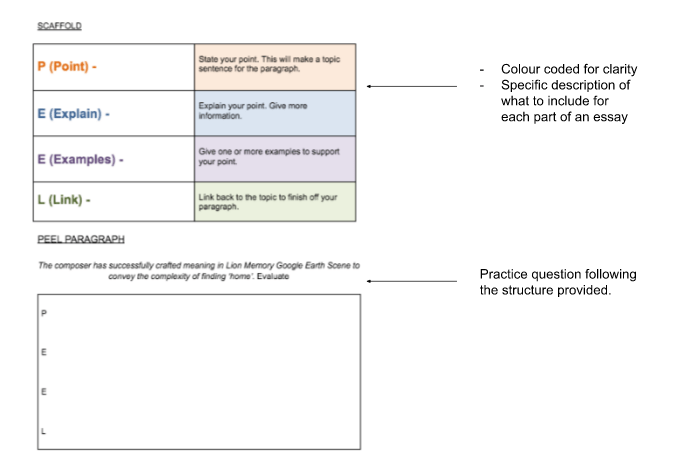
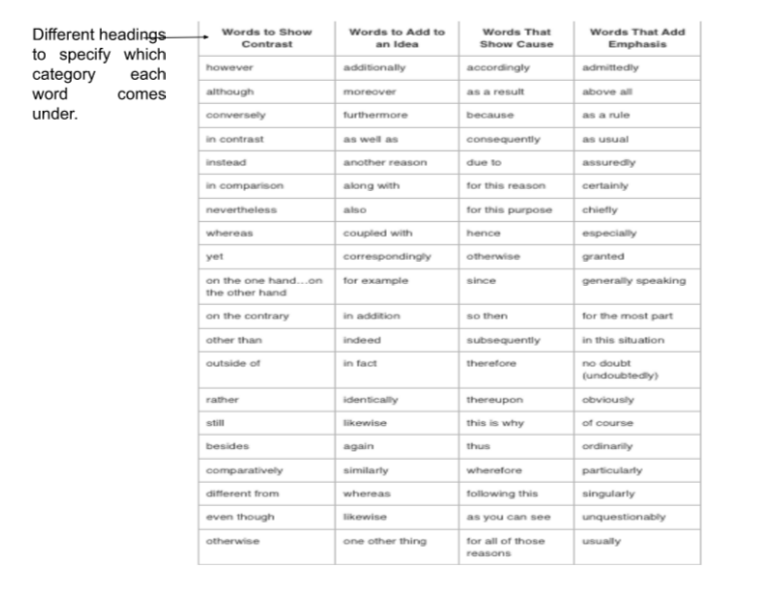
This piece of evidence was created as part of an assessment for a unit in university in order to assist students with a PEEL paragraph response. Each part was dissected, colour coded and explained to highlight what should be included in each section. Below, I have provided a sample question for students to practice writing a PEEL paragraph in order to increase their familiarity with it. Sentence starters were provided to students for extra assistance with their vocabulary.
Critical Reflection
Educators, according to APST 1.5, must “demonstrate knowledge and understanding of strategies for differentiating teaching to meet the specific learning needs of students across the full range of abilities” (AITSL, n.d.). Differentiation is centred upon recognising that each learner is unique. Teaching practices must be altered to suit the needs of each learner. When students commence a new topic, I must assume that they have limited experience with it. Students with additional needs may face difficulties recalling information, forming connections between ideas and extending their vocabulary. I Presented a scaffolded template in conjunction with sentence starters to assist students who struggle with writing PEEL paragraphs. Sentence starters act as a ‘starting point’ prior to commencing scaffolded writing tasks and therefore is helpful in developing students’ as critical thinkers (Pedaste et al. 2015). This is particularly helpful for students with dyslexia, of which 1 in 3 students in a classroom may have (Patterson, 2019). McFarlane et al (2012) affirm that students with dyslexia often lack confidence and have low self-esteem. In addition to this, poor speech and literacy skills are also prominent. Thus, providing a breakdown of the PEEL structure in conjunction with the sentence starters as a means of differentiation would assist students in increasing their self-efficacy through understanding the layout, purpose and execution of a PEEL paragraph.
 Holly’s Blog