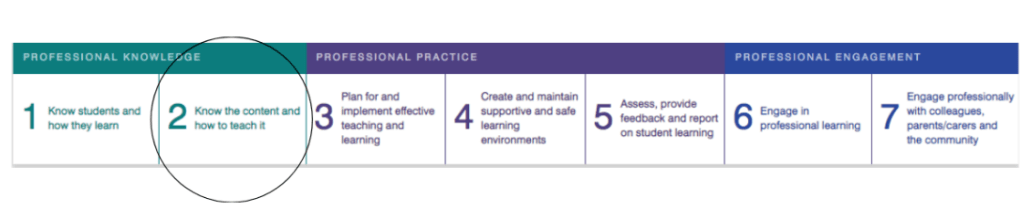
Overview of Standard
APST 2 encompasses educators understanding the content they teach students’ with particular regard to its alignment with curriculum expectations. Educators must recognise how Aboriginal and Torres Strait Islander Histories can be embedded within lesson plans in addition to utilising numeracy, literacy and information and Communication Technology (ICT) to deliver effective lessons. Considering the evolving and prolific use of nature of ICT in the modern context, it is pivotal that I consider the ethical and suitable use of technology to enhance learning.
Evidence: 2.6 – Information & Communication Technology (ICT)
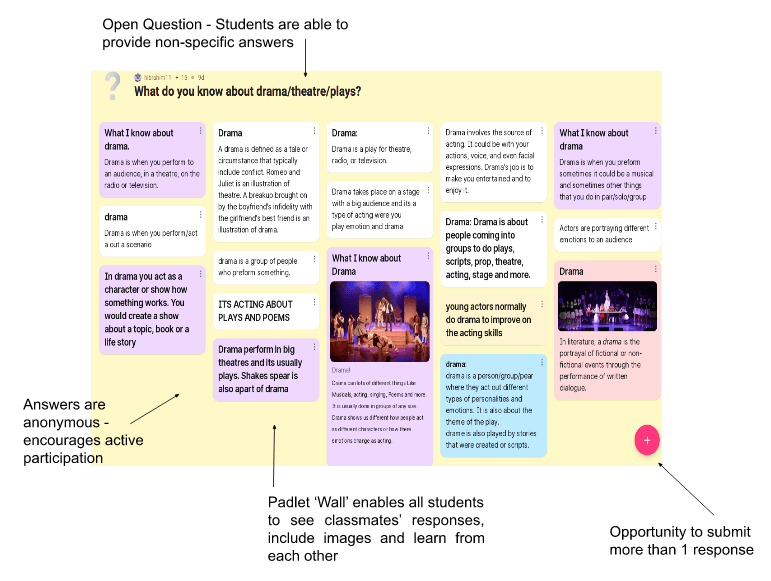
The evidence provided reflects an interactive padlet that I created for students (Year 9) whilst on placement. This relates to focus area 2.6 (Information and Communication Technology – ICT). The purpose of this piece of evidence is to elucidate how I used ICT as a form of diagnostic assessment whilst also enabling students to extend their initial understanding through learning from each other.
Critical Reflection
Information Communication Technology (ICT) has been an integral and influential tool utilised within learning endeavours, increasing the accessibility of resources and promoting student engagement (Churchill et al., 2013). it is not useful to simply ‘know’ the content and transmit it but rather ascertain that which students know in order to scaffold subsequent lessons effectively.
During my placement, I created a ‘padlet wall’ for students to post what they knew about drama/theatre/plays, maintaining a broad and general mind-mapping space. I utilised ICT as a means of ‘augmentation’, a concept alluded within the SAMR model, whereby digital technology replaced the traditional form of learning to promote engagement (Romrell et al., 2014). Such improvement comes from active involvement rather than educators direct transmission of content. It was important for this to occur as it aligns with Vygotsky’s Constructivist theory whereby students are framed as active citizens and learners. It is pivotal for learners to share their thoughts but also be open to examining the viewpoints of their peers in order to extend their own understanding and elevate their self-efficacy (Jones, 2008). The use of Padlet also enabled students’ answers to be anonymous, helpful in ensuring students with anxiety were not excluded from the learning activity (Pollock, 2016). I thereby developed a rapport with students through integrating their interests into the lesson, ensured that goals were not unattainable and used this as a form of diagnostic assessment in order to scaffold subsequent lessons in an effective manner (AITSL, 2017).
 Holly’s Blog