
Overview of Standard
APST 3 is concerned with planning, structuring and delivering lessons that feature a range of resources that assist a wide range of learners. Educators must consider the difficulty of goals and practicality of achieving them within each learning program. Additionally, ensuring non-verbal and verbal communication methods are maintained within the classroom aids in providing optimal structured teaching and learning experiences.
Evidence: 3.3 – Use Teaching Strategies
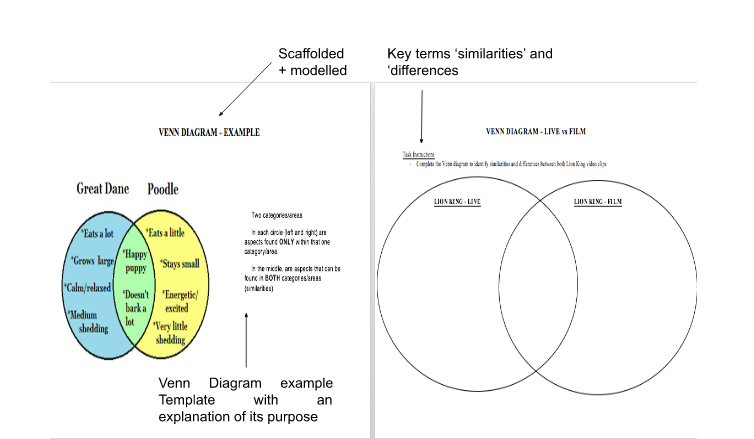
In order to address focus area 3.3, this piece of evidence reflects how I provided explicit instruction, modelling and scaffolding in order for students to comprehend the task. The venn diagram also highlights interaction with the general capability, ‘numeracy’ foregrounded within ACARA policies.
Critical Reflection
APST 3.3 is underpinned by educators incorporating a wide range of teaching strategies to enhance learning (AITSL, n.d.). Educators, according to Social Learning Theory, can utilise modelling as a way for students to develop their self-efficacy (Bandura, 1976). Thus, the evidence provided is a reflection of this focus area being put into practice as I provided students with a template and explanation prior to engaging in the task. The general capability, ‘Numeracy’, mirrored within the use of the venn diagram enables students to visually comprehend the similarities and differences between the two visual texts examined (Rice, 1978). It is a critical teaching strategy that ensures a wide range of resources and methods of communication are used to simplify and enhance learning. Thus, I ensured that I was paired with explicit verbal instruction, as indicated within APST 3, in order for this to be effective for learners.
 Holly’s Blog