
Overview of Standard
APST 4 ensures educators consider how to maintain a supportive, safe and inclusive learning environment for all members of the school community. This includes their physical and emotional security whereby all students’ active participation is encouraged and challenging behaviour is minimised through non-confrontational approaches. Additionally, educators are beckoned to ensure students’ navigation of the virtual world is completed responsibly and ethically for educational purposes.
Evidence: 4.4 – Maintain Student Safety
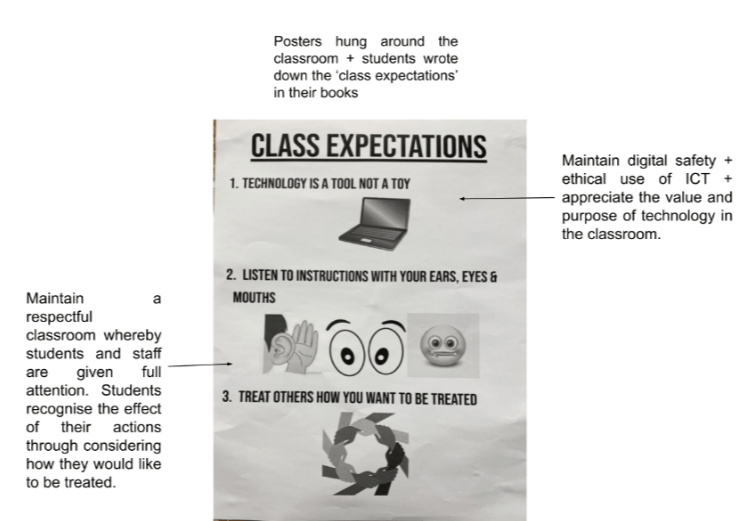
To address Focus Area 4.4, during my professional experience I created ‘Class Expectations’ for my Year 7 and 9 classes. I provided this and went over it during my first lesson with each cohort in order to establish firm rules prior to undertaking learning during the school term.
Critical Reflection
APST 4.4 involves describing “strategies that support students’ wellbeing and safety working within school and/or system, curriculum and legislative requirements”. (AITSL, n.d.) Educators must ensure that ‘duty of care’ is maintained. This involves ensuring that the learning environment is safe, supportive and fosters all students development (NSW Department of Education, 2021). In order to maintain duty of care, the evidence provided pertains to ‘class expectations’ that I created during my placement at a co-educational high school. Many students in my classes presented with requiring additional assistance with behaviour. Given that I believed practical involvement would greatly benefit all learners rather than ‘direct’ instruction, it was critical that I set expectations regarding how they should conduct themselves. This would ensure the maintenance of a safe, supportive environment (AITSL, 2017, 1.6, 3.3, 3.5, 4.1, 4.2, 4.3 and 4.4).
As indicated within APST 4, both the emotional and physical security of students is essential. Thus, the class expectations were built upon the establishment of the ‘Responsible Thinking Process’. I believe that students’ must be prompted to actively think about how their behaviour affects their learning, the climate of their learning space and those around them. Thus, students’ would perceive these expectations not merely as an ‘instruction’ but rather a lifestyle, encouraging them to be respectful, mindful and ethical (Ford, 1994).
 Holly’s Blog