
Overview of Standard
APST 5 is concerned with utilising informal and formal assessment to ascertain students’ understanding and progression in the learning cycle. Through diagnostic, formative and summative tasks, educators are able to provide constructive feedback and utilise data to inform their future planning, construction of resources
Evidence: 5.4 – Interpret Student Data
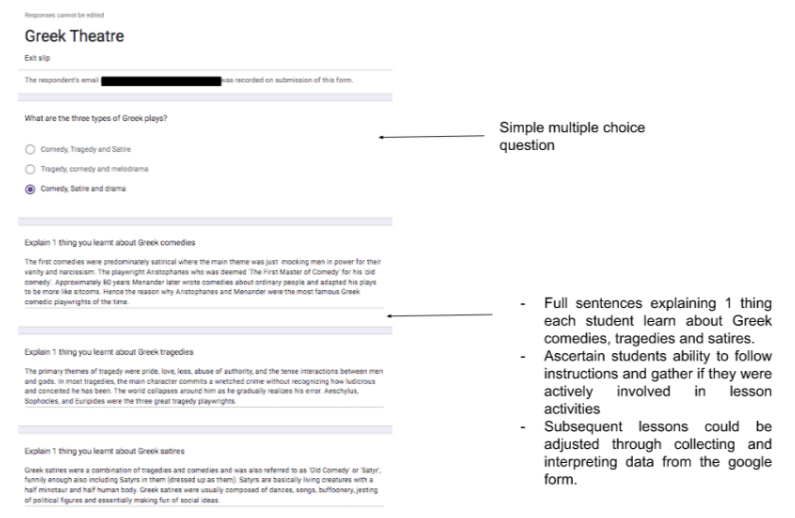
The evidence provided reflects how I addressed focus area 5.4 through the creation of a Google Form ‘exit slip’ on one of my placements. This enabled me to ascertain students’ comprehension of content and adjust future lessons based upon their level of retention.
Critical Reflection
APST 5.4 requires educators to be able to “demonstrate the capacity to interpret student assessment data to evaluate student learning and modify teaching practice” (AITSL, n.d.).
Diagnostic assessment is crucial as it enables me to ascertain students’ initial knowledge and skill level prior to engaging in further study (Tweed & Wilkinson, 2012). The evidence above reflects how I utilised Google Forms whilst on placement to conduct ‘diagnostic assessment’. Through this, I was able to evaluate students’ capabilities and implement effective pedagogical practices that align with their current understanding (Ugodulunwa, 2008). As data pertains to gathering information to inform decision making (AISNSW, 2017), such data gathered regarding students knowledge of Greek Theatre enabled me to interpret their understanding critically and adjust subsequent teaching practices (Scanlon et al., 2003). This demonstrates my interaction with APST 5.4 and highlights the necessity of interpreting student data as a means of professional development in order to provide optimal learning experiences.
 Holly’s Blog