
Overview of Standard
APST 7 recognises that educators’ must be continuously involved in strengthening their rapport with all members of the school community. This includes staff, parents/caregivers and wider professional networks. Behaviour and actions are foregrounded within legislative and educational policies, ensuring that engagement is both ethical and effective in maintaining a positive rapport.
Evidence: 7.4 – Understand the role of external professionals and community representatives in broadening teachers’ professional knowledge and practice
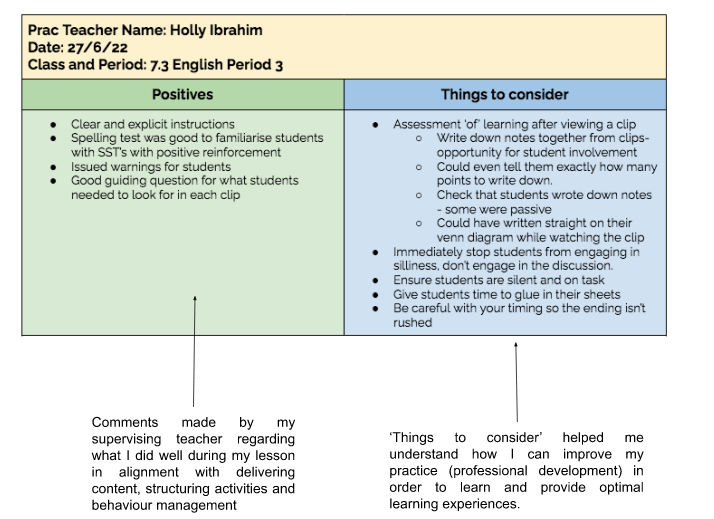
The evidence provided reflects feedback I received from my supervising teacher whilst on placement. It features the ‘positives’ of my teaching as well as ‘things to consider’ so that I can position myself as a reflective educator, taking constructive criticism and understanding how I can improve practice to benefit learners and grow as an educator.
Critical Reflection
As AITSL (n.d.) stipulates, APST 7.4 is focused upon understanding “the role of external professionals and community representatives in broadening teachers’ professional knowledge and practice”.
The evidence I have provided features feedback I received from my supervising teacher after I scaffolded and taught a Year 7 English lesson. I was provided with ‘positives’ and ‘things to consider’ to elucidate that which I did well and that which would benefit from additional consideration. Such constructive feedback would enhance my teaching as I reflect upon my practice in order to provide more effective learning experiences. It is beneficial to seek assistance from individuals with extensive experience as they have often encountered students with similar needs, content within the curriculum and learning methods. This is supported through Atkinson et al (2021) stating that “learners are more receptive to feedback if it comes from a source that they perceive as credible, and with whom they have developed rapport” (p.441). Atkinson et al (2021) further affirm that “feedback is an educational tool as well as a social interaction between learner and supervisor, in the context of a respectful and trusting relationship. It challenges the learner’s thinking and supports the learner’s growth” (p.441). In addition to being an educator, I was also a learner, seeking growth through understanding how I can improve. Through receiving such feedback I was able to adjust my lesson plan and practice in the subsequent lesson.
 Holly’s Blog