REFERENCE LIST

AISNSW. (2017). Working with Data. https://www.aisnsw.edu.au/teachers-and-staff/research-and-data-in-schools/data-in-schools/working-with-data

Atkinson, A., Watling, C. J., & Brand, P. L. (2022). Feedback and coaching. European journal of pediatrics, 181(2), 441-446.

Australian Curriculum, Assessment and Reporting Authority. (2022). General Capabilities (Version 8.4). https://australiancurriculum.edu.au/resources/curriculum-connections/portfolios/food-and-wellbeing/general-capabilities/

Australian Curriculum, Assessment and Reporting Authority. (2022). Cross-curriculum priorities (Version 8.4). https://australiancurriculum.edu.au/f-10-curriculum/cross-curriculum-priorities/

Australian Institute for Teaching and School Leadership. (2017). Australian Professional Standards for Teachers. https://www.aitsl.edu.au/standards

Bada, S. O., & Olusegun, S. (2015). Constructivism learning theory: A paradigm for teaching and learning. Journal of Research & Method in Education, 5(6), 66-70. DOI: 10.9790/7388-05616670

Bandura, A. (1977). Social learning theory. Englewood Cliffs, NJ: Prentice Hall.

Churchill, S., Godinho, S., Johnson, N. F.; Keddie, A., Letts, W.; Lowe, K.; Mackay, J.; McGill, M.; Moss, J.; Nagel, M.; Shaw, K.; Vick, M. (2013). Teaching: Making a difference (3rd ed.). John Wiley & Sons.

Ford, E. E. (1994). Discipline for home and school: Teaching children to respect the rights of others through responsible thinking based on perceptual control theory. Brandt Publications.

Jones, R. C. (2008). The “why” of class participation: A question worth asking. College Teaching, 56(1), 59-63. http://www.tandfonline.com/loi/ vcol20#.U2PoEFdcw60

Kesler, A., Shamir-Inbal, T., & Blau, I. (2022). Active learning by visual programming: Pedagogical perspectives of instructivist and constructivist code teachers and their implications on actual teaching strategies and students’ programming artifacts. Journal of Educational Computing Research, 60(1), 28-55.

Le, Nam. (2009). The Boat. Vintage

MacFarlane,  A.,  Albrair,  A.,  Marshall,  C.  R.,  &  Buchanan,  G.  (2012). Phonological    working           memory           impacts           on             information searching: An investigation of dyslexia. IIiX 2012 -Proceedings 4th Information Interactionin Context Symposium: Behaviors, Interactions, Interfaces, Systems, 27–34. https://doi.org/10.1145/2362724.2362734

Maslow, A. H. (1943). A theory of human motivation. Psychological Review, 50(4), 370-96.

NSW Department of Education. (2021). Employee responsibility. https://education.nsw.gov.au/about-us/rights-and-accountability/department-of-education-code-of-conduct/employee-responsibility

NSW Government. (2023). Engaging our Parents and Carers. https://education.nsw.gov.au/parents-and-carers/initiatives/engaging-our-parents-and-carers.

Patterson, D. (2019). Dyslexia in the Classroom. Australian Dyslexia Association. https://dyslexiaassociation.org.au/dyslexia-in-the-classroom-and-pre-service-teacher-training/

Pedaste, M., M. Mäeots, L.A. Siiman, T. de Jong, S.A.N. van Riesen, E.T. Kamp, C.C. Manoli, Z.C. Zacharia, and E. Tsourlidaki. 2015. Phases of inquiry-based learning: Definitions and the inquiry cycle. Educational Research Review 14: 47–61.

Pollock, M. (2016). Smart Tech Use for Equity. The Education Digest, 81, 40-45. https://search.proquest.com/docview/1768622785?accountid=14723

Rice, A. (1978). Planned Change, Organizational Innovations and Patterns of Implementation with Particular Reference to the Curriculum. Unpublished Ph.D. thesis,  Monash University.

Romrell, D., Kidder, L., & Wood, E. (2014). The SAMR model as a framework for evaluating mLearning. Online Learning Journal, 18(2). https://www.learntechlib.org/p/183753/.

Scanlan, J. M., Care, W. D., & Udod, S. (2002). Unravelling the unknowns of reflection in classroom teaching. Journal of advanced nursing, 38(2), 136-143

Tweed, M., & Wilkinson, T. (2012). Diagnostic testing and educational assessment. The clinical teacher, 9(5), 299-303.

Ugodulunwa, C. A. (2008). Fundamentals of educational measurement and evaluation. Jos: Fab Educational Books

United Nations. (1948). Universal Declaration of Human Rights. https://www.un.org/en/about-us/universal-declaration-of-human-rights

Vygotsky, L. S. (1978). Mind in society: The development of higher psychological processes. Cambridge, MA: Harvard University Press.
APST 2.2

Evidence

Critical Reflection

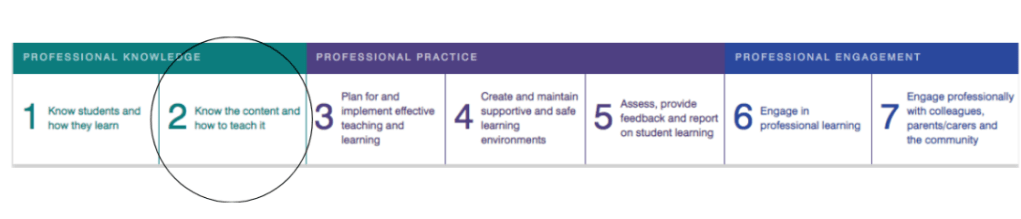
APST 2 is concerned with the content that educators are expected to teach students. Specifically, focus area 2.2 emphasises that educators must consider how to effectively organise content in the teaching and learning cycle in order to engage in meaningful learning experiences (AITSL, 2017). The evidence I have provided for APST 2.2 reflects the integration of the cross-curriculum priority (CCP), Asia & Australia’s Engagement with Asia as well as the General Capabilities (GC); Intercultural Understanding, Personal and Social Capability and ICT (ACARA, n.d.). 

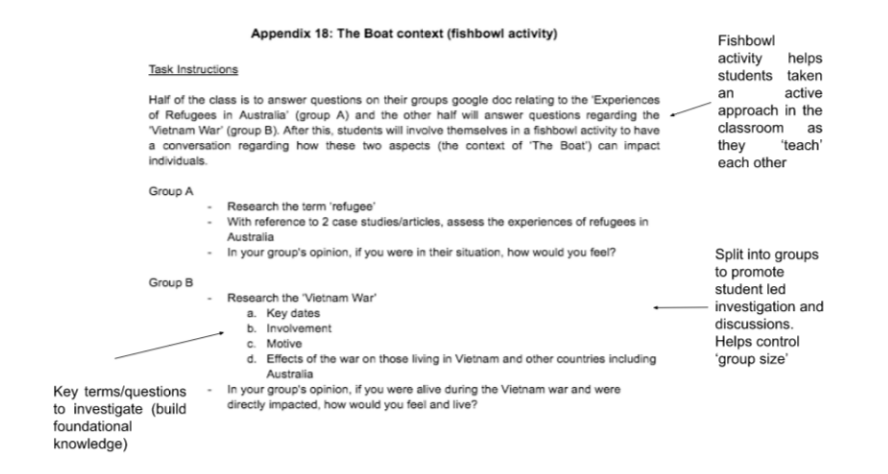
‘The Boat Context – Fishbowl activity) was created as an activity for senior students, as part of a university assessment, to complete in order to develop their contextual understanding prior to engaging in further learning. Rather than focusing on providing a ‘textbook’ definition of refugees experiences in Australia and the Vietnam War, I constructed this task to demonstrate how it is more effective for students to engage in inquiry learning, collaboratively. The aforementioned CCP is reflected within this English task as ACARA (n.d.) states, “students can explore and appreciate the diverse range of traditional and contemporary texts from and about the peoples and countries of Asia, including texts written by Australians of Asian heritage” . The multimodal adaptation of Nam Le’s text, ‘The Boat’ by Matt Huynh acts as the focus text upon which students are conducting their investigation. It features the harrowing experiences of individuals seeking refuge in Australia during the Vietnam War (Le, 2009). Thus, this activity would simultaneously illuminate the experiences of the Asian community, foregrounded within this CCP, and strengthen students’ intercultural Understanding, a prominent GC. This GC encompasses recognising cultures, developing empathy and respect towards them. Through the evidence provided, it is clear that students develop their understanding of how contextual factors can influence authors’ storytelling and communication of their experience. Thus, this aids in bolstering students’ intercultural understanding and becoming informed, active citizens. Additionally, interaction with the GC ‘ICT’ and ‘Personal and Social Capability’ is apparent through students working collaboratively on a google doc, answering set questions and engaging in discussion regarding their findings. This further enables students to develop their sense of self-efficacy, maintain themselves as active learners and limits engagement in passive learning (Kesler et al., 2022). 

Ultimately, content was considered and organised in an effective way, as illuminated within APST 2.2, in order for students to engage in meaningful learning and interact with the CCP and GC’s mentioned. 

STANDARD 7 – ‘ENGAGE PROFESSIONALLY WITH COLLEAGUES, PARENTS/CAREGIVERS & THE COMMUNITY’

Overview of Standard

APST 7 recognises that educators’ must be continuously involved in strengthening their rapport with all members of the school community. This includes staff, parents/caregivers and wider professional networks. Behaviour and actions are foregrounded within legislative and educational policies, ensuring that engagement is both ethical and effective in maintaining a positive rapport.

Evidence: 7.4 – Understand the role of external professionals and community representatives in broadening teachers’ professional knowledge and practice

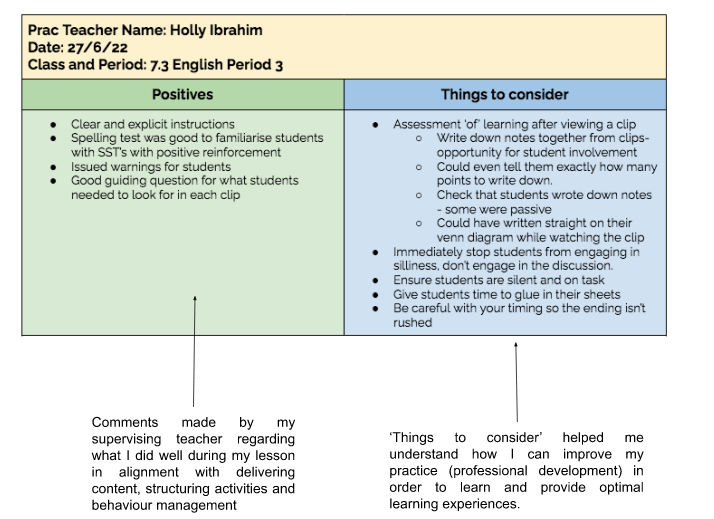
The evidence provided reflects feedback I received from my supervising teacher whilst on placement. It features the ‘positives’ of my teaching as well as ‘things to consider’ so that I can position myself as a reflective educator, taking constructive criticism and understanding how I can improve practice to benefit learners and grow as an educator. 

Critical Reflection

As AITSL (n.d.) stipulates, APST 7.4 is focused upon understanding “the role of external professionals and community representatives in broadening teachers’ professional knowledge and practice”.

The evidence I have provided features feedback I received from my supervising teacher after I scaffolded and taught a Year 7 English lesson. I was provided with ‘positives’ and ‘things to consider’ to elucidate that which I did well and that which would benefit from additional consideration. Such constructive feedback would enhance my teaching as I reflect upon my practice in order to provide more effective learning experiences. It is beneficial to seek assistance from individuals with extensive experience as they have often encountered students with similar needs, content within the curriculum and learning methods. This is supported through Atkinson et al (2021) stating that “learners are more receptive to feedback if it comes from a source that they perceive as credible, and with whom they have developed rapport” (p.441). Atkinson et al (2021) further affirm that “feedback is an educational tool as well as a social interaction between learner and supervisor, in the context of a respectful and trusting relationship. It challenges the learner’s thinking and supports the learner’s growth” (p.441). In addition to being an educator, I was also a learner, seeking growth through understanding how I can improve. Through receiving such feedback I was able to adjust my lesson plan and practice in the subsequent lesson.

STANDARD 5 – ‘ASSESS, PROVIDE FEEDBACK & REPORT ON STUDENT LEARNING’

Overview of Standard

APST 5 is concerned with utilising informal and formal assessment to ascertain students’ understanding and progression in the learning cycle. Through diagnostic, formative and summative tasks, educators are able to provide constructive feedback and utilise data to inform their future planning, construction of resources

Evidence: 5.4 – Interpret Student Data

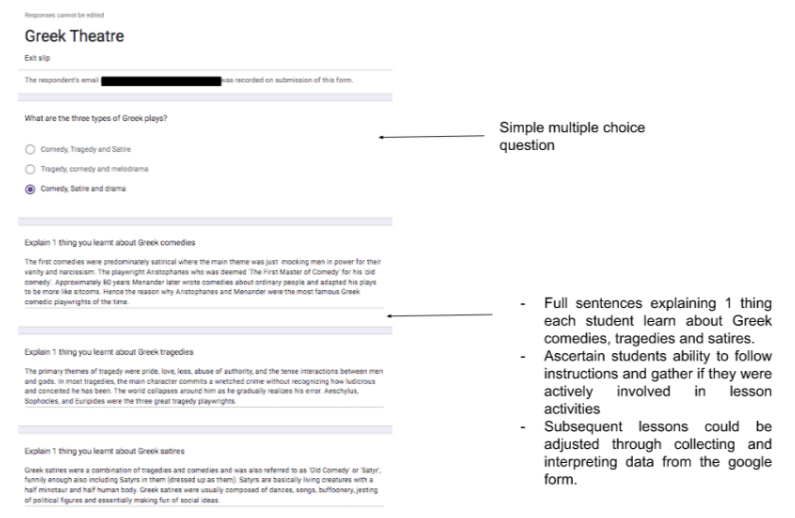
The evidence provided reflects how I addressed focus area 5.4 through the creation of a Google Form ‘exit slip’ on one of my placements. This enabled me to ascertain students’ comprehension of content and adjust future lessons based upon their level of retention.

Critical Reflection

APST 5.4 requires educators to be able to “demonstrate the capacity to interpret student assessment data to evaluate student learning and modify teaching practice” (AITSL, n.d.).

Diagnostic assessment is crucial as it enables me to ascertain students’ initial knowledge and skill level prior to engaging in further study (Tweed & Wilkinson, 2012). The evidence above reflects how I utilised Google Forms whilst on placement to conduct ‘diagnostic assessment’. Through this, I was able to evaluate students’ capabilities and implement effective pedagogical practices that align with their current understanding (Ugodulunwa, 2008). As data pertains to gathering information to inform decision making (AISNSW, 2017), such data gathered regarding students knowledge of Greek Theatre enabled me to interpret their understanding critically and adjust subsequent teaching practices (Scanlon et al., 2003). This demonstrates my interaction with APST 5.4 and highlights the necessity of interpreting student data as a means of professional development in order to provide optimal learning experiences.

STANDARD 4 – ‘CREATE & MAINTAIN SUPPORTIVE & SAFE LEARNING ENVIRONMENTS’

Overview of Standard

APST 4 ensures educators consider how to maintain a supportive, safe and inclusive learning environment for all members of the school community. This includes their physical and emotional security whereby all students’ active participation is encouraged and challenging behaviour is minimised through non-confrontational approaches. Additionally, educators are beckoned to ensure students’ navigation of the virtual world is completed responsibly and ethically for educational purposes.

Evidence: 4.4 – Maintain Student Safety

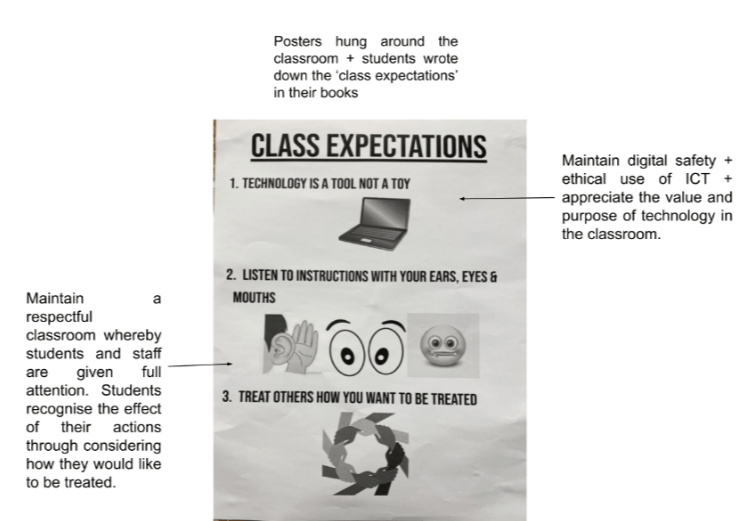
To address Focus Area 4.4, during my professional experience I created ‘Class Expectations’ for my Year 7 and 9 classes. I provided this and went over it during my first lesson with each cohort in order to establish firm rules prior to undertaking learning during the school term. 

Critical Reflection

APST 4.4 involves describing “strategies that support students’ wellbeing and safety working within school and/or system, curriculum and legislative requirements”. (AITSL, n.d.) Educators must ensure that ‘duty of care’ is maintained. This involves ensuring that the learning environment is safe, supportive and fosters all students development (NSW Department of Education, 2021). In order to maintain duty of care, the evidence provided pertains to ‘class expectations’ that I created during my placement at a co-educational high school. Many students in my classes presented with requiring additional assistance with behaviour. Given that I believed practical involvement would greatly benefit all learners rather than ‘direct’ instruction, it was critical that I set expectations regarding how they should conduct themselves. This would ensure the maintenance of a safe, supportive environment (AITSL, 2017, 1.6,  3.3, 3.5, 4.1, 4.2, 4.3 and 4.4).

As indicated within APST 4, both the emotional and physical security of students is essential. Thus, the class expectations were built upon the establishment of the ‘Responsible Thinking Process’. I believe that students’ must be prompted to actively think about how their behaviour affects their learning, the climate of their learning space and those around them. Thus, students’ would perceive these expectations not merely as an ‘instruction’ but rather a lifestyle, encouraging them to be respectful, mindful and ethical (Ford, 1994).

STANDARD 3 – ‘PLAN FOR AND IMPLEMENT EFFECTIVE TEACHING & LEARNING’

Overview of Standard

APST 3 is concerned with planning, structuring and delivering lessons that feature a range of resources that assist a wide range of learners. Educators must consider the difficulty of goals and practicality of achieving them within each learning program. Additionally, ensuring non-verbal and verbal communication methods are maintained within the classroom aids in providing optimal structured teaching and learning experiences. 

Evidence: 3.3 – Use Teaching Strategies

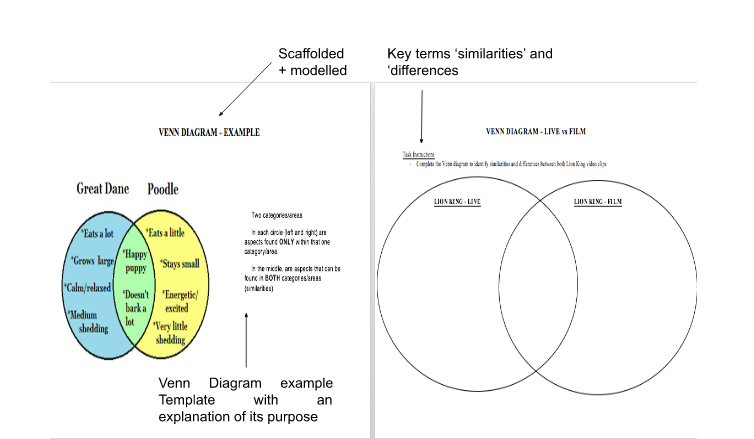
In order to address focus area 3.3, this piece of evidence reflects how I provided explicit instruction, modelling and scaffolding in order for students to comprehend the task. The venn diagram also highlights interaction with the general capability, ‘numeracy’ foregrounded within ACARA policies. 

Critical Reflection

APST 3.3 is underpinned by educators incorporating a wide range of teaching strategies to enhance learning (AITSL, n.d.). Educators, according to Social Learning Theory, can utilise modelling as a way for students to develop their self-efficacy (Bandura, 1976). Thus, the evidence provided is a reflection of this focus area being put into practice as I provided students with a template and explanation prior to engaging in the task. The general capability, ‘Numeracy’, mirrored within the use of the venn diagram enables students to visually comprehend the similarities and differences between the two visual texts examined (Rice, 1978). It is a critical teaching strategy that ensures a wide range of resources and methods of communication are used to simplify and enhance learning. Thus, I ensured that I was paired with explicit verbal instruction, as indicated within APST 3, in order for this to be effective for learners.

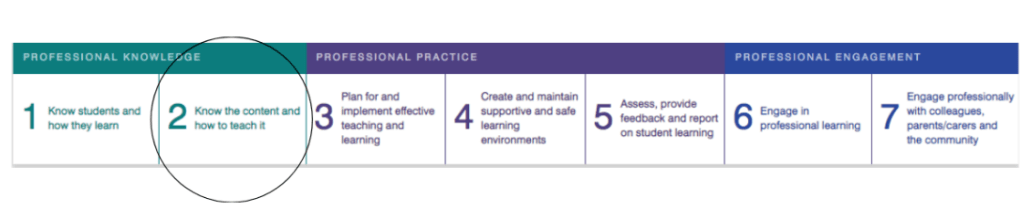
STANDARD 2 – ‘KNOW THE CONTENT & HOW TO TEACH IT’

Overview of Standard

APST 2 encompasses educators understanding the content they teach students’ with particular regard to its alignment with curriculum expectations. Educators must recognise how Aboriginal and Torres Strait Islander Histories can be embedded within lesson plans in addition to utilising numeracy, literacy and information and Communication Technology (ICT) to deliver effective lessons. Considering the evolving and prolific use of nature of ICT in the modern context, it is pivotal that I consider the ethical and suitable use of technology to enhance learning.

Evidence: 2.6 – Information & Communication Technology (ICT)

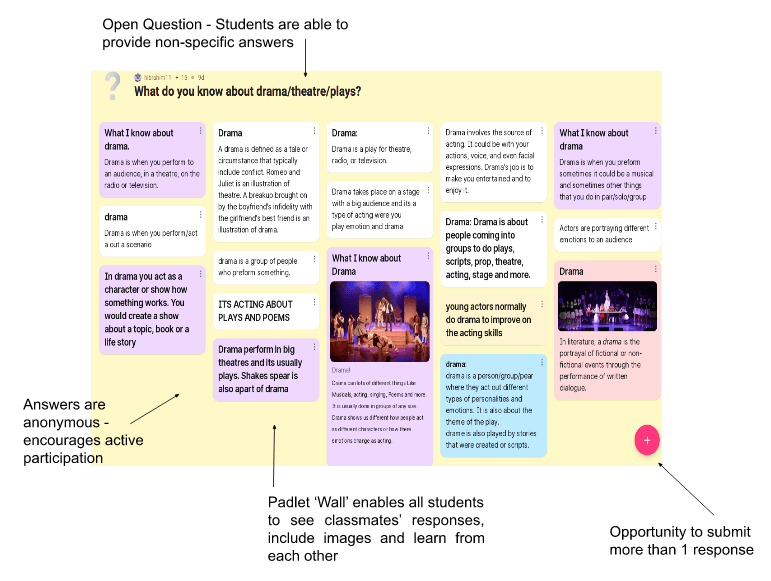
The evidence provided reflects an interactive padlet that I created for students (Year 9) whilst on placement. This relates to focus area 2.6 (Information and Communication Technology – ICT). The purpose of this piece of evidence is to elucidate how I used ICT as a form of diagnostic assessment whilst also enabling students to extend their initial understanding through learning from each other.

Critical Reflection

Information Communication Technology (ICT) has been an integral and influential tool utilised within learning endeavours, increasing the accessibility of resources and promoting student engagement (Churchill et al., 2013). it is not useful to simply ‘know’ the content and transmit it but rather ascertain that which students know in order to scaffold subsequent lessons effectively.

During my placement, I created a ‘padlet wall’ for students to post what they knew about drama/theatre/plays, maintaining a broad and general mind-mapping space. I utilised ICT as a means of ‘augmentation’, a concept alluded within the SAMR model, whereby digital technology replaced the traditional form of learning to promote engagement (Romrell et al., 2014). Such improvement comes from active involvement rather than educators direct transmission of content. It was important for this to occur as it aligns with Vygotsky’s Constructivist theory whereby students are framed as active citizens and learners. It is pivotal for learners to share their thoughts but also be open to examining the viewpoints of their peers in order to extend their own understanding and elevate their self-efficacy (Jones, 2008). The use of Padlet also enabled students’ answers to be anonymous, helpful in ensuring students with anxiety were not excluded from the learning activity (Pollock, 2016). I thereby developed a rapport with students through integrating their interests into the lesson, ensured that goals were not unattainable and used this as a form of diagnostic assessment in order to scaffold subsequent lessons in an effective manner (AITSL, 2017).

STANDARD 1 – ‘KNOW STUDENTS AND HOW THEY LEARN’

Overview of Standard

APST 1 requires the educator to understand the context of their class, that is, each learners’ background, specific learning abilities, needs and manner in which they learn most effectively. Specifically, this enables students with diverse needs as well as Aboriginal and Torres Strait Islander Students to receive tailored care that promotes their inclusion in the learning process. Through this, the educator is able to provide optimal learning experiences that lead to students’ full development as a learner and individual.

Evidence: 1.5 – Differentiate teaching to meet the specific learning needs of students across the full range of abilities

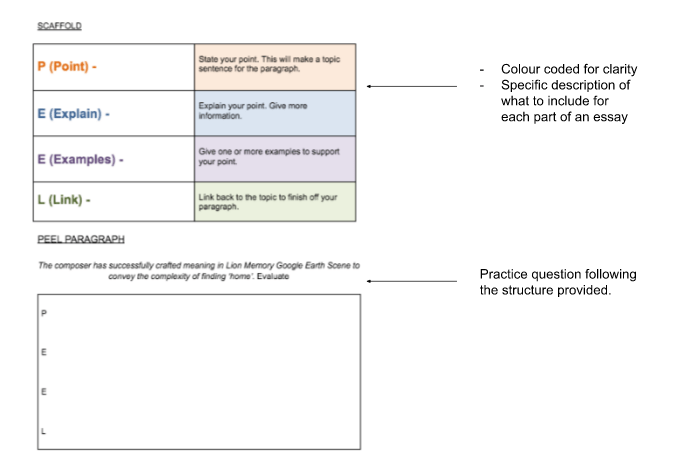
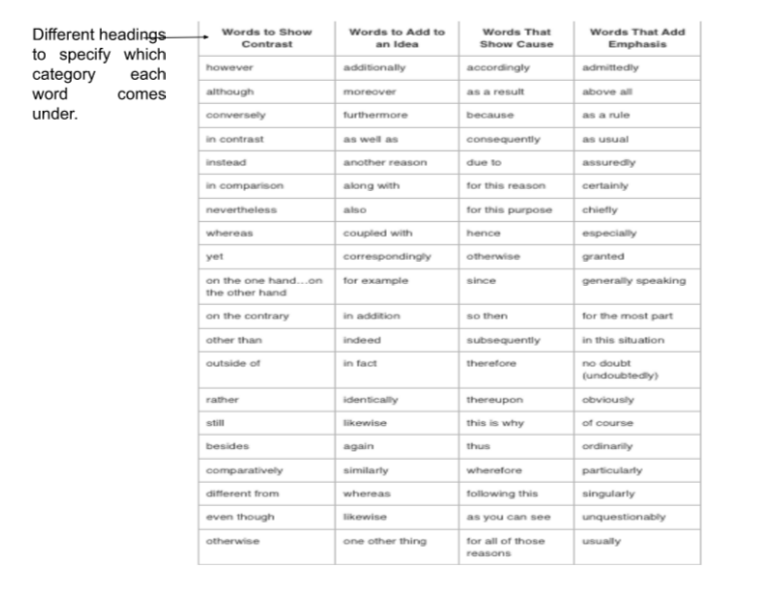
This piece of evidence was created as part of an assessment for a unit in university in order to assist students with a PEEL paragraph response. Each part was dissected, colour coded and explained to highlight what should be included in each section. Below, I have provided a sample question for students to practice writing a PEEL paragraph in order to increase their familiarity with it. Sentence starters were provided to students for extra assistance with their vocabulary.

Critical Reflection

Educators, according to APST 1.5, must “demonstrate knowledge and understanding of strategies for differentiating teaching to meet the specific learning needs of students across the full range of abilities” (AITSL, n.d.). Differentiation is centred upon recognising that each learner is unique. Teaching practices must be altered to suit the needs of each learner. When students commence a new topic, I must assume that they have limited experience with it. Students with additional needs may face difficulties recalling information, forming connections between ideas and extending their vocabulary. I Presented a scaffolded template in conjunction with sentence starters to assist students who struggle with writing PEEL paragraphs. Sentence starters act as a ‘starting point’ prior to commencing scaffolded writing tasks and therefore is helpful in developing students’ as critical thinkers (Pedaste et al. 2015). This is particularly helpful for students with dyslexia, of which 1 in 3 students in a classroom may have (Patterson, 2019). McFarlane et al (2012) affirm that students with dyslexia often lack confidence and have low self-esteem. In addition to this, poor speech and literacy skills are also prominent. Thus, providing a breakdown of the PEEL structure in conjunction with the sentence starters as a means of differentiation would assist students in increasing their self-efficacy through understanding the layout, purpose and execution of a PEEL paragraph. 

RATIONALE

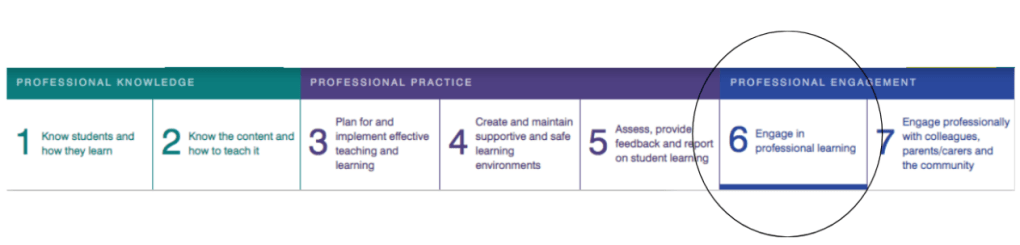
Included within the Australian Professional Standards for Teachers, APST 6 is focused upon professional engagement. Specifically, it elucidates how educators are required to engage in professional learning in order to provide optimal learning experiences (AITSL, 2017, 6.1, 6.2, 6.3 & 6.4). Through such professional development, educators are able to differentiate learning so that it caters for all students and reflects best practice. It is thereby a learning experience for educators as they adjust their mindset and practice to reflect inclusivity, achieve success through collaboration and integrate resources that enhance learning. As a pre-service educator, I aim to continually renew my understanding of ‘professional learning’. The education profession is constantly evolving and therefore practice must adapt to the ever-changing demands of our context.

An area that I believe requires further development, given that I have not encountered many opportunities to strengthen this, is how I interact with parents/caregivers, reflected within APST 3.7.

It can often be difficult to formulate a strong, positive rapport with caregivers/parents and maintain it throughout the duration of the school year. Reflection upon this can enable me to monitor how often I email, call or meet with parents/caregivers to engage in two-way conversation regarding the social, emotional and academic development of their child. NSW Department of Education’s ‘Parent and Carer Engagement Framework’ lists 5 principles of effective engagement including: ‘give me access’, ‘communicate with me openly’, ‘partner with me’, ‘understand my situation’ and ‘guide my choices’ (NSW Government, 2023). Such framework can enable APST 6.4 to be achieved as it allows professional development to occur, altering my perception of engagement with parents/caregivers and ensuring everyone is ‘on the same page’ regarding their childs’ development.

Moreover, asking for feedback from supervisors or other staff can help me understand areas which may require further development. It is an opportunity that should not be perceived as ‘degrading’ or an ‘attack’ on my professional abilities but rather my desire to be the best educator I can be through taking constructive criticism. Collaboration with colleagues is also imperative as each individual bears a unique perspective, scaffolded through their respective experiences. Sharing resources, whether in person or digitally, for example through joining social media groups i.e. NSW English Discussion Group can enable us to have a vast array of work that caters for a range of learners and formulate a strong professional network. 

EDUCATIONAL PHILOSOPHY

All individuals are welcomed and encouraged to involve themselves in positive learning experiences that strengthens their sense of self’ and perception of the world around (Universal Declaration of Human Rights [UDHR], 1948). It is crucial, as an educator, that I uphold a safe and supportive learning environment. This includes embracing diversity, recognising the non-linear process of learning and encouraging all students’ active participation so that they feel comfortable in the learning space. Educators cannot simply ‘transmit’ knowledge as this does not catalyse active development (Bada & Olusegun, 2015). However, students must be provided with assistance in order to develop, academically and social-emotionally , through maintaining a firm rapport and perceiving myself as a ‘guide’ rather than a dominating, instructive figure. Adoption of a constructivist approach, with particular reference to Vygotsky (1978), would ensure students are the primary focus, engaged in activities such as discussions, debates and inquiry tasks that require them to be actively involved.

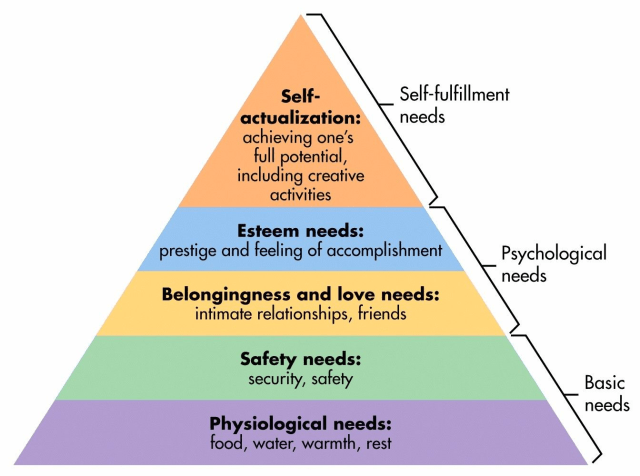
Additionally, a humanist approach involves taking into consideration students’ context including their physical wellbeing, social, emotional and academic backgrounds in order to understand how they shape their behaviour and attitude towards learning (Maslow, 1943). I am to develop a rapport with students, knowing ‘how they learn’ and that which may affect their ability to process information or develop strong connections with peers. Students must also be prompted to grow as an individual and learner. Challenging them, within reason, may encourage them to think deeply and remain curious, aspects which are necessary to limit stagnation. Ultimately, all students are unique and must be seen, heard and appreciated within the learning environment.

Design a site like this with WordPress.com
Get started